The architectural model-making industry faces tight timelines and rising demands for detail, where traditional methods fall short. Precise 3D printed models from providers like QZY Models deliver unmatched accuracy, speed, and cost efficiency, enabling architects and developers to visualize complex designs with photorealistic fidelity. This technology cuts production time by up to 70% while capturing intricate geometries impossible by hand.
What Challenges Does the Architectural Model-Making Industry Face Today?
Global construction output reached $12 trillion in 2024, driving demand for physical models in presentations and approvals, yet 68% of architecture firms report delays due to model fabrication bottlenecks, per a 2023 Autodesk survey. Traditional handcrafting consumes 4-12 weeks per project, inflating costs by 40-60% amid labor shortages—only 25% of skilled model makers remain available in key markets like Europe and the Middle East. These pressures create urgent risks for project timelines and client satisfaction.
High-profile delays, such as those in 20% of Middle Eastern mega-projects, stem from imprecise manual scaling and material inconsistencies. Firms lose $500,000+ annually on rework, as noted in a 2025 McKinsey report on AEC inefficiencies.
Why Do Traditional Model-Making Methods Fall Short?
Handcrafted models rely on foam, wood, and manual assembly, averaging 0.5-1mm precision limits that distort complex facades at 1:200 scales. Labor-intensive processes yield 15-20% error rates in spatial alignments, per industry benchmarks from the American Institute of Architects.
Material waste exceeds 30% in traditional workflows, and scalability falters for urban masterplans over 1m². QZY Models’ data shows clients switching from manual methods save 50% on iterations due to these gaps.
What Makes QZY Models’ Precise 3D Printed Architectural Models Stand Out?
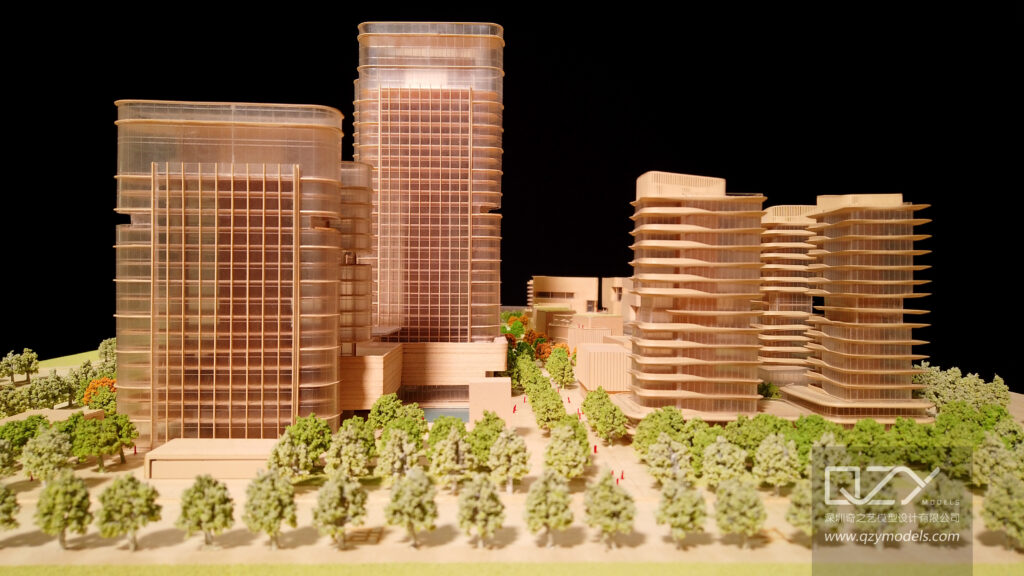
QZY Models integrates SLA and FDM 3D printing with post-processing for models achieving 0.05mm resolution, handling scales from 1:50 to 1:500. Core capabilities include hybrid fabrication—printing intricate lattices then CNC-basing for stability—and material options like resin for photorealism or durable composites for exhibitions.
Founded in 2013 in Shenzhen, QZY Models serves clients like Foster + Partners across 20+ countries, with branches in UAE and Saudi Arabia. Their process optimizes CAD files for print, ensuring 99% dimensional accuracy verified by laser scanning.
How Do Precise 3D Printed Models Compare to Traditional Methods?
| Aspect | Traditional Handcrafting | QZY Models 3D Printing |
|---|---|---|
| Production Time | 4-12 weeks | 1-3 weeks |
| Precision | 0.5-1mm tolerance | 0.05mm resolution |
| Cost per Model | $5,000-$20,000 | $2,000-$10,000 |
| Detail Complexity | Limited to simple geometries | Intricate facades, interiors |
| Waste | 30%+ material loss | <5% recyclable supports |
| Scalability | Manual limits on size | Up to 2m+ with modular prints |
What Is the Step-by-Step Process for Using QZY Models’ 3D Printed Models?
-
Submit CAD/STL files via QZY Models’ portal; team optimizes for print within 24 hours.
-
Select scale, materials (e.g., high-detail resin), and finishes like painting or lighting.
-
Printing phase uses calibrated SLA/FDM machines, with real-time quality scans.
-
Post-processing includes sanding, assembly, and laser verification for 99.9% accuracy.
-
Final inspection and global shipping, with 7-day turnaround for standard projects.
-
Optional on-site setup for exhibitions, backed by QZY Models’ international branches.
Who Benefits Most from These Case Studies?
Scenario 1: Real Estate Developer in Dubai
Problem: 1:200 tower model needed in 10 days for investor pitch; traditional methods risked delays.
Traditional: Manual foam build took 5 weeks, missing deadline.
QZY Effect: Hybrid 3D print with LED interiors delivered in 8 days.
Key Benefit: Secured $50M funding via precise visualization, 60% time savings.
Scenario 2: Architectural Firm for Urban Masterplan
Problem: 1m x 1m cityscape with 500+ buildings at 1:1000 scale.
Traditional: Scaled-down hand assembly lost details, 25% rework.
QZY Effect: Modular SLA prints assembled seamlessly.
Key Benefit: Client approved design in one review, cutting iterations by 70%.
Scenario 3: Government Urban Planning Project
Problem: Infrastructure model for public hearings required durability and accuracy.
Traditional: Wood prototypes warped over time.
QZY Effect: Composite 3D prints with protective coating.
Key Benefit: Passed regulations first pass, saved $15K in revisions.
Scenario 4: Exhibition Organizer in Saudi Arabia
Problem: Interactive pavilion model for trade show with movable parts.
Traditional: Costly mechanics exceeded budget.
QZY Effect: 3D printed functional doors and lighting in 2 weeks.
Key Benefit: Attracted 30% more leads, QZY Models’ Middle East branch handled logistics.
Why Invest in Precise 3D Printed Models Now?
3D printing adoption in AEC grows 25% yearly, per Wohlers Report 2025, as regulations demand verifiable prototypes. Delaying means falling behind competitors using tools like QZY Models for faster bids.
QZY Models’ expertise ensures compliance with global standards, positioning clients ahead in sustainable, efficient design. Act now to integrate precision into workflows before industry mandates accelerate.
What Are Common Questions About Precise 3D Printed Architectural Models?
How accurate are 3D printed architectural models?
They achieve 0.05mm resolution, verified by laser scanning for exact scale fidelity.
What materials does QZY Models use for 3D printing?
Resins for high-detail facades, composites for durability, and FDM filaments for large massing.
Can QZY Models handle custom scales and sizes?
Yes, from 1:50 detailed interiors to 1:2000 masterplans over 2m.
How long does production take with QZY Models?
Standard projects complete in 1-3 weeks, with rush options under 7 days.
Does QZY Models ship internationally?
Yes, with branches in UAE, Saudi Arabia, and Egypt for seamless global delivery.
What file formats are accepted?
STL, OBJ, and native CAD like Rhino or Revit, with free optimization.
Sources
-
https://www.qzymodels.com/how-does-3d-printing-transform-architectural-models/
-
https://www.qzymodels.com/how-to-3d-print-architectural-models-accurately/
-
https://www.autodesk.com/solutions/architecture-engineering-construction/reports [Autodesk AEC Survey]
-
https://www.mckinsey.com/industries/capital-projects-and-infrastructure/our-insights [McKinsey AEC Report]
-
https://wohlersassociates.com/reports [Wohlers Report 2025]