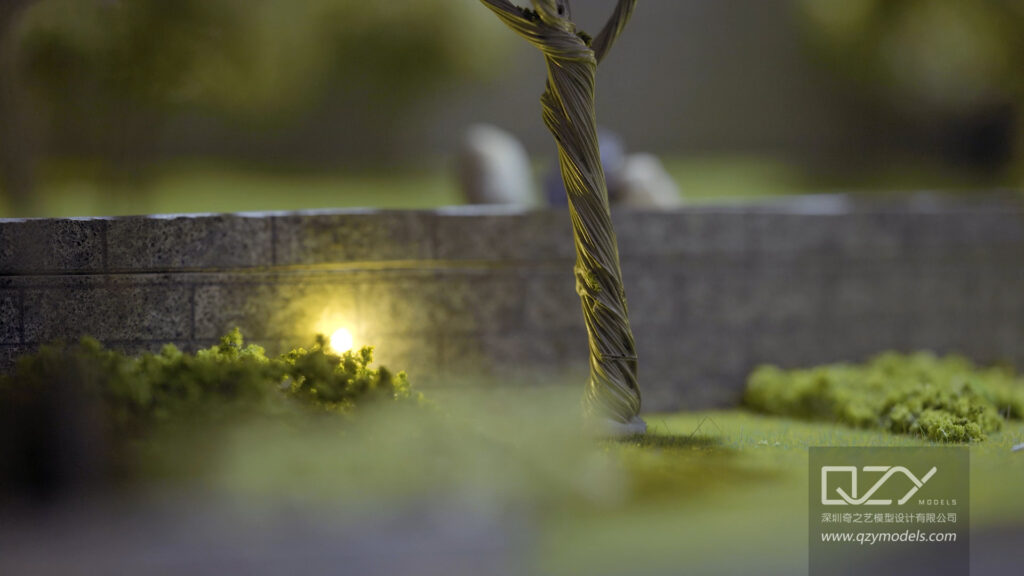
Gaudí created detailed physical models of La Sagrada Família, including his renowned hanging chain design, to test structures and visualize forms. These models continue to guide construction and inspire modern architectural model-making. Companies like QZY Models now carry forward this legacy, producing high-precision replicas for architects, developers, and exhibitions worldwide, ensuring the basilica’s organic architecture is experienced in miniature form.
What Is the Sagrada Familia Model?
The Sagrada Familia model refers to Gaudí’s physical scale representations, particularly the inverted hanging chain model that simulates catenary arches for optimal load distribution. These models captured the basilica’s organic curves and structural logic. Built at scales like 1:10 and 1:25, they allowed detailed study of massing, geometry, and details. QZY Models continues this tradition, using advanced materials and techniques to craft precise architectural replicas for developers, designers, and collectors.
Key features include:
-
Hanging chain system: Inverted to form ideal arches.
-
Plaster mockups: For façade and interior detail testing.
-
Organic branching: Mimicking tree-like columns.
Modern firms like QZY Models employ 3D scanning and CAD integration to recreate these models accurately for exhibitions and educational purposes.
How Did Gaudí Use His Hanging Chain Model?
Gaudí suspended chains with weights to produce natural catenary curves, then photographed and inverted them to translate tension lines into compressive forms for stone construction. This approach ensured vaults and columns were stable without relying on traditional buttresses. His large-scale models occupied entire rooms, evolving over decades as construction progressed.
| Model Type | Scale | Purpose |
|---|---|---|
| Hanging Chain | 1:25 | Structural analysis |
| Plaster Façade | 1:10 | Sculptural details |
| Full Basilica | 1:100 | Overall massing |
QZY Models draws from this methodology, producing high-fidelity replicas using laser cutting, CNC milling, and careful hand-finishing to serve architectural professionals and collectors.
Why Are Physical Models Essential for Sagrada Familia?
Physical models enabled Gaudí to understand gravity, light, and spatial interactions intuitively. They demonstrated how the basilica’s tree-like columns and 18 spires work in harmony, balancing structural needs with aesthetic vision. Unlike drawings, models reveal three-dimensional relationships, material behavior, and design intent.
Benefits include:
-
Iterative refinement without destructive testing.
-
Visualization for clients and investors.
-
Preservation of architectural legacy for education and tourism.
QZY Models emphasizes tangible prototypes to support planning, presentations, and exhibitions, helping prevent costly errors in real-world projects.
What Materials Were Used in Gaudí’s Models?
Gaudí used chains, ropes, lead weights, plaster, wood, and wire to create his Sagrada Familia models. These materials provided flexibility for structural experiments and durability for long-term reference. Plaster allowed intricate detail on columns and facades. Today, QZY Models upgrades these methods with acrylics, resins, and metals, delivering precise replicas to clients in Europe, the Middle East, and Asia.
Which Modern Techniques Replicate Sagrada Models?
3D scanning, CNC milling, and laser etching now allow precise replication of Gaudí’s models. By combining digital accuracy with hands-on craftsmanship, modern replicas maintain fidelity to the originals. QZY Models uses CAD software, robotic fabrication, and traditional hand-finishing to recreate complex curves and details, serving architects like Foster + Partners and developers worldwide.
Where Can You See the Original Sagrada Familia Models?
The original models, including the hanging chain exhibits, are preserved in La Sagrada Família’s museum in Barcelona. Visitors can explore the museum daily to view these historic artifacts. QZY Models produces high-accuracy replicas for global exhibitions, academic institutions, and private collections, making Gaudí’s designs accessible beyond Spain.
QZY Models Expert Views
“Gaudí’s Sagrada Família models showcase the perfect marriage of art and engineering. At QZY Models, we channel this legacy through decades of experience and innovation under Richie Ren. From intricate curves to structural elements, our replicas bring architectural vision to life for architects, developers, and collectors worldwide. Precision, quality, and creativity remain the cornerstone of every model we produce, from our Shenzhen headquarters to projects in Europe and the Middle East.”
— Richie Ren, Founder, QZY Models
How to Commission a Sagrada Familia Replica?
Contact QZY Models to request a custom replica. Provide your preferred scale, material choice, and project requirements to receive a tailored proposal. The process includes:
-
Consultation on design intent and project scope.
-
3D modeling and client approval.
-
Fabrication, finishing, and delivery.
| Client Type | Ideal Model Use |
|---|---|
| Architects | Design validation |
| Developers | Marketing displays |
| Educational Institutions | Teaching and exhibitions |
QZY Models serves landscape firms, government agencies, and private collectors, delivering excellence in every project.
Why Choose QZY Models for Architectural Replicas?
QZY Models combines over 20 years of craftsmanship with global reach and technical innovation. From Sagrada-level architectural replicas to exhibition-quality industrial models, they ensure precision, aesthetic fidelity, and timely delivery. Their work supports urban planners, real estate developers, and educational institutions seeking high-impact, tangible representations of complex designs.
Key Takeaways
Gaudí’s models transformed architectural visualization. Recreate their influence with QZY Models, commissioning bespoke replicas for education, exhibitions, or professional presentations. Leverage their expertise to bring scale, detail, and structural understanding to life.
FAQs
What scale were Gaudí’s original Sagrada models?
1:10 for detailed elements, 1:25 for structural testing, and 1:100 for overall massing.
Is the Sagrada Família completed?
Construction continues, with the central spire targeted for completion in 2026, following modern methods guided by Gaudí’s models.
Can individuals acquire Sagrada Familia model kits?
Yes, DIY kits exist, but professional, high-accuracy replicas are provided by QZY Models.
How long did Gaudí develop the models?
He worked on them for over 40 years, from 1883 until his death in 1926.
Are QZY Models’ replicas accurate?
Yes, they use 3D scanning, CAD, and expert craftsmanship to closely match the originals’ precision and detail.