Industrial Scale Models for Oil and Gas Projects
A Comprehensive Guide to Design, Fabrication, and Presentation of Oil & Gas Industrial Models in 2026
{{image: wide shot of industrial oil and gas scale model with refinery, pipelines, and offshore platform}}
Introduction
Industrial-scale models for oil and gas projects are precision-engineered tools that combine visualization, technical accuracy, and operational realism. These models are used by engineers, investors, project managers, and clients to communicate complex infrastructure, drilling operations, pipeline layouts, and facility designs in a tangible, easy-to-understand format.
While digital simulations and VR provide interactive experiences, physical models allow stakeholders to assess scale, spatial relationships, and equipment arrangements instantly. For international projects, these models also demonstrate operational planning, safety workflows, and logistics layouts, giving investors and operators confidence in project feasibility.
In 2026, industrial model fabrication has evolved into a sophisticated integration of traditional craftsmanship and advanced manufacturing technologies—including CNC machining, 3D printing, laser cutting, precision LED systems, and modular construction—ensuring highly accurate, visually impactful, and transportable models.
This article explores the complete process, design considerations, scale selection, fabrication methods, and presentation strategies for industrial-scale oil and gas models.
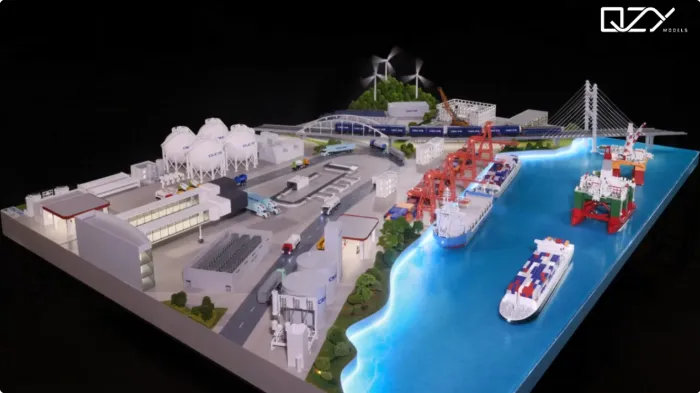
Industrial-scale energy model showing wind turbines, offshore Rigs and distribution channels
1. Purpose of Industrial Oil & Gas Models
Industrial oil and gas models serve multiple critical purposes:
1.1 Design Visualization
Models allow engineers and project planners to assess complex layouts of rigs, pipelines, storage tanks, and processing facilities. A well-crafted 3D model can reveal spatial conflicts, optimize equipment placement, and improve site safety planning, which 2D schematics often fail to convey.
1.2 Investor and Stakeholder Communication
Investors and stakeholders often find technical drawings difficult to interpret. Physical models simplify communication, enabling decision-makers to understand:
Rig placement and operational flow
Pipeline networks and storage solutions
Infrastructure accessibility and site logistics
Environmental and topographical integration
1.3 Training and Operational Simulation
High-detail industrial models are used to simulate drilling operations, safety procedures, and logistical workflows, helping staff visualize potential challenges before implementation.
1.4 Marketing and Exhibition
At trade shows, client presentations, and boardrooms, industrial models demonstrate technical competence and operational scale, creating a strong impression and building trust with investors and partners.
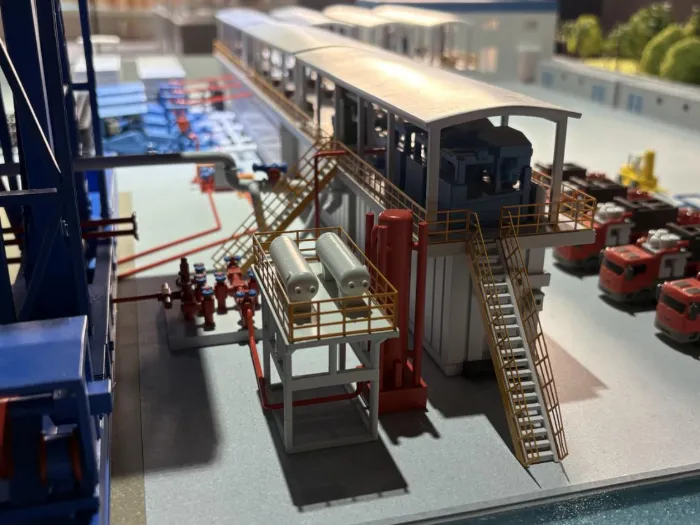
Detailed drilling rig and pipeline components on an industrial oil and gas model
2. Scale Selection and Detailing
The scale of a model directly impacts size, presentation clarity, cost, and level of detail. Choosing the right scale requires balancing visual realism with practical fabrication and transportation constraints.
| Scale | Typical Use | Advantages | Limitations |
|---|---|---|---|
| 1:1000 – 1:500 | Site planning, masterplan overview | Large area coverage, quick comprehension | Limited small-component detail |
| 1:200 – 1:100 | Facility-level, rig layout | High detail, precise component representation | Larger footprint, higher fabrication cost |
| 1:50 – 1:40 | Equipment-level, operational demonstration | Exceptional realism, ideal for client engagement | Very large, requires modular construction |
High-detail features often included in industrial-scale models:
Swamp rigs, land rigs, and offshore platforms
Pipelines, valves, and OCTG pipe systems
Cranes, helipads, and support infrastructure
EPF facilities, warehouses, and transport routes
Environmental elements like terrain, water, and vegetation
By combining multi-scale detailing, industrial models can communicate both overall layout and equipment-level precision.
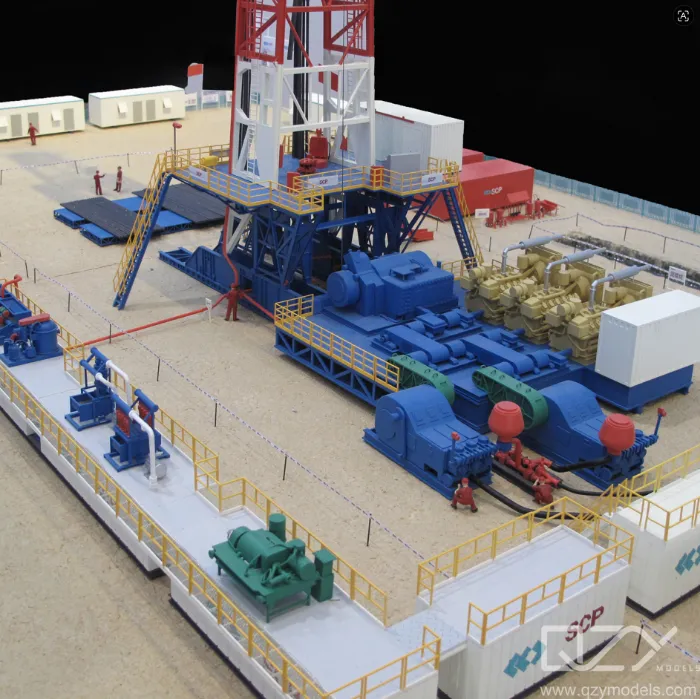
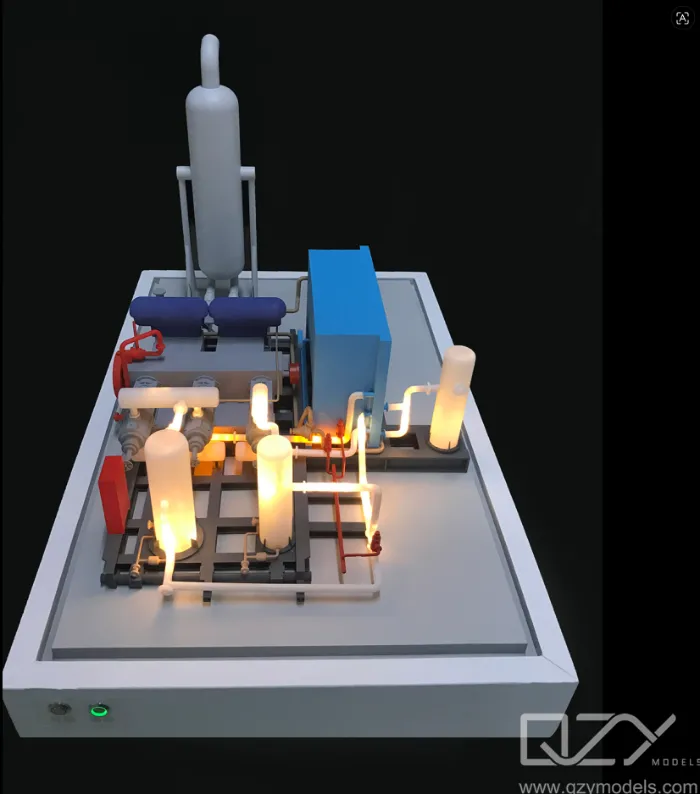
Comparison of industrial oil and gas model scales showing varying levels of detail
3. Material Strategy and Fabrication
Material selection is critical for durability, precision, and visual fidelity. Industrial models often combine multiple materials to achieve realism and robustness.
Common Materials:
Acrylic (PMMA): For tanks, transparent structures, and pipelines
ABS / Resin (3D Printed): For complex rig machinery, valves, and fine equipment
Wood / Foam Board: For platforms, base structures, and terrain modeling
Metal: For cranes, piping frameworks, structural reinforcement, and realistic mechanical details
High-end models also incorporate precision paint, decals, and texturing to replicate the look of metal, concrete, and industrial coatings.
Prototyping
Critical or complex components are often prototyped to verify:
Scale accuracy
Component fit
Visual realism
Mechanical operation for moving parts
Image Idea: Material samples including acrylic, resin, and metal components
Caption:
Material selection and prototype testing for industrial oil & gas models
SEO Alt Text:
{{image: material samples for model making: acrylic sheets, resin parts, metal rods}}
4. Precision Fabrication
Industrial models require extreme accuracy and consistency. Fabrication techniques include:
CNC Machining: Terrain, base platforms, and rig structures
Laser Cutting: Pipelines, storage tanks, and support framework
3D Printing: Complex equipment, valves, and rig accessories
Manual Crafting & Detailing: Surface finishing, assembly adjustment, and painting
Each component undergoes dimensional verification to maintain operational realism and structural stability.
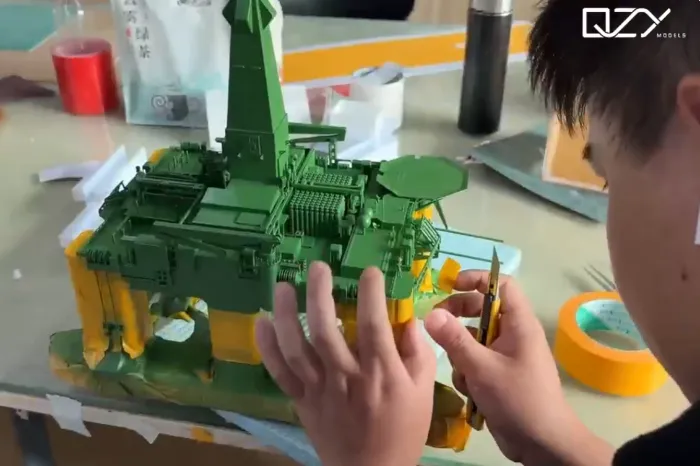
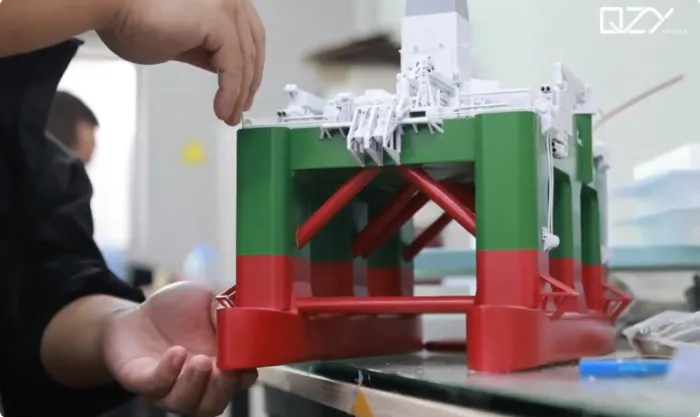
Precision Hand Crafting and Detailing
5. Modular Assembly and Detailing
Industrial models are often modular to support transportation and on-site assembly. The assembly process involves:
Structural mounting of rigs, storage tanks, and pipelines
Installation of operational components such as cranes and EPF facilities
Integration of terrain, water features, and vegetation
Placement of auxiliary structures like warehouses and service roads
Modular construction ensures models are safe for shipping, easy to assemble, and reusable for exhibitions or client demonstrations.
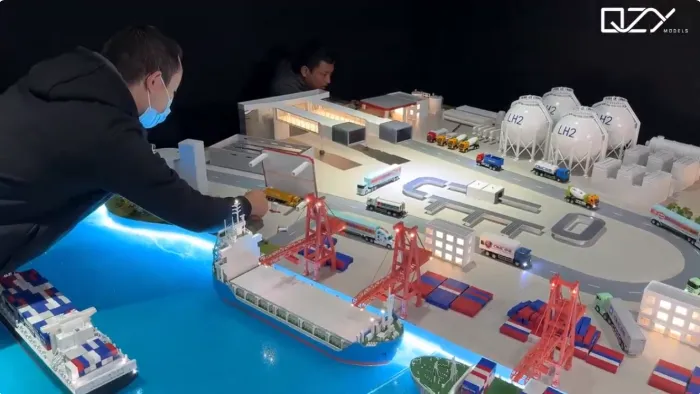
Modular assembly of industrial oil & gas model components
6. Lighting and Operational Simulation
Lighting enhances realism and presentation value. Industrial models can incorporate:
LED lighting for rigs, pipelines, and tanks
Operational simulation with moving parts
Zoning for different functional areas
Interactive lighting to represent workflow or drilling stages
Advanced lighting allows investors and stakeholders to visualize the project under operational conditions.
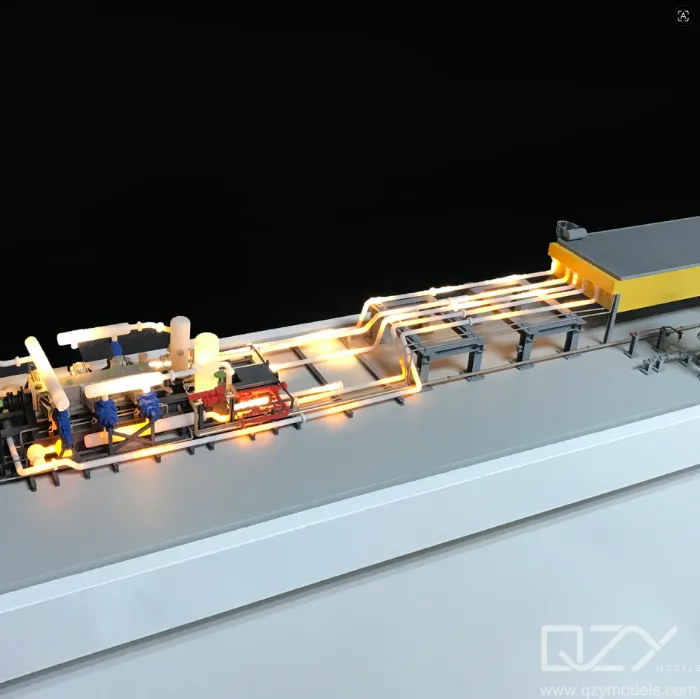
LED lighting and operational simulation in industrial oil & gas model
7. Quality Assurance and Testing
High-end industrial models undergo multi-step quality control, including:
Structural integrity and alignment verification
Visual and surface finish inspection
Lighting and interactive system testing
Modular connection and on-site assembly testing
This ensures the model is durable, accurate, and presentation-ready.
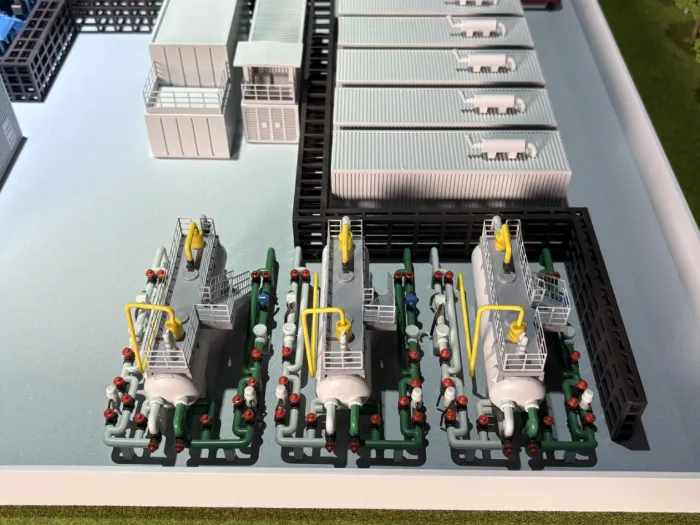
Final quality inspection of industrial oil and gas model
8. Packaging, Shipping, and Installation
For international clients, shipping and installation are critical:
Custom aluminum transport cases with precision-cut foam protect each component
Modular design reduces shipping volume and cost
Step-by-step guides or instructional videos simplify on-site assembly
Models can be reused for exhibitions, presentations, or client meetings
These measures ensure safe delivery and seamless setup, even across multiple countries.
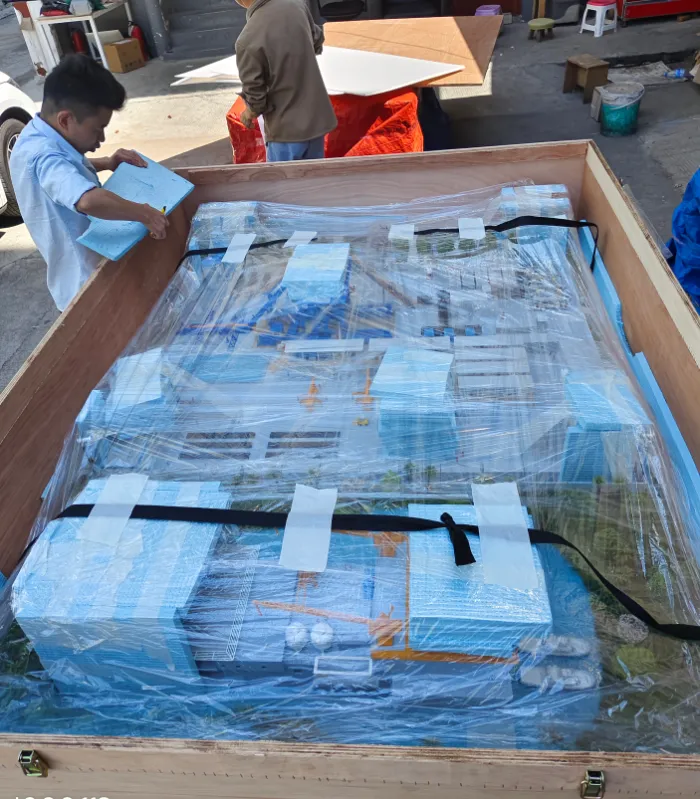
Industrial model in transport case
{{image: trade show booth displaying illuminated industrial oil and gas scale model with visitors}}
Conclusion
Industrial-scale oil and gas models are highly specialized, precision-engineered tools that combine:
Technical accuracy
Operational realism
Visual clarity
Transportable modular design
From design analysis to fabrication, assembly, lighting integration, and global shipping, these models enhance stakeholder understanding, support decision-making, and demonstrate project professionalism.
In 2026, combining advanced manufacturing technologies, modular design, and expert craftsmanship ensures industrial models remain indispensable for investors, engineers, and clients worldwide.
About QZY Models
QZY MODELS is a professional model-making company specializing in architectural scale models, industrial models, and urban planning models for global clients.
With more than 20 years of experience, the team provides complete services including:
architectural model design
model fabrication
international packaging and shipping
on-site installation support
These integrated services ensure that every model can be safely transported and efficiently presented anywhere in the world.
www.qzymodels.com