The Complete Guide to Architectural Model Shipping and Transportation (2026)

The Complete Guide to Architectural Model Shipping and Transportation (2026)

Safe Packaging, Modular Design, and Global Delivery for Scale Models

Architectural scale models are essential tools for architects, developers, and investors to visualize projects before construction begins. These models often represent complex buildings, industrial systems, or entire urban developments with a high level of precision and craftsmanship.

However, once a model is completed, another major challenge begins: how to safely transport and install the architectural model without damaging its delicate structure.

Whether the model is being shipped across a city, transported to another country, or displayed at international exhibitions, architectural model shipping and transportation require careful planning, professional packaging, and specialized logistics.

This guide explains the best practices used by professional model makers to package, transport, and install architectural models safely anywhere in the world.

{{image: technicians carefully placing a detailed architectural model into a custom foam-lined wooden crate}}

Why Architectural Model Transportation Is Challenging

Unlike most manufactured products, architectural scale models are fragile, unique, and often irreplaceable. A single model can contain thousands of small components including miniature buildings, cranes, pipelines, landscaping, and lighting systems.

During transportation, models may face several risks:

vibration during truck or air transport

temperature and humidity changes

impacts during loading and unloading

customs inspection handling

installation constraints at the destination

Without professional packaging and planning, these factors can easily damage delicate structures.

For this reason, experienced model makers integrate transportation planning directly into the model design process rather than treating it as a final step.
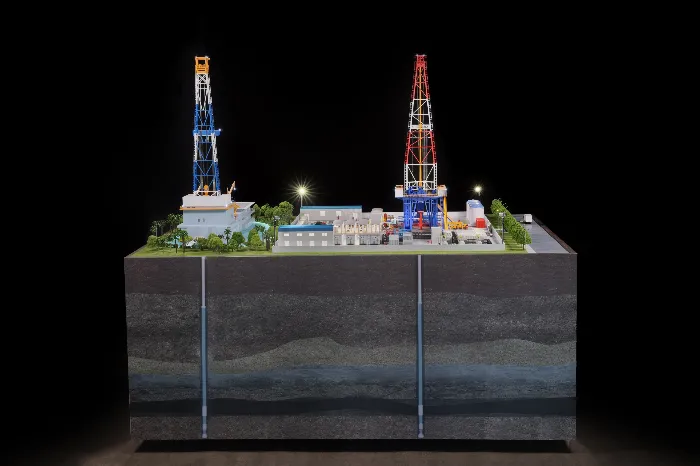
Large detailed oil & gas drilling site scale model on black display base, featuring two illuminated rigs (blue-orange tower and red-white tower), surface facilities with buildings, vehicles and trees, plus cross-section subsurface geological layers with two vertical drill pipes – professional industrial exhibition model
Large model small components


Modular Architectural Model Design for Global Shipping

One of the most effective ways to protect models during transport is modular architectural model design.

Instead of producing a single large model, the structure is divided into multiple detachable modules.

Each module represents a section of the model and can be safely packaged and transported independently.

{{image: exploded view of a modular architectural model showing multiple detachable sections}}

Advantages of Modular Model Structures

Modular models offer several major advantages:

Improved protection

Each module can be individually wrapped and cushioned using protective materials.

Reduced shipping volume

Smaller modules allow models to fit more efficiently into shipping crates.

Lower international shipping costs

Optimized packaging reduces freight volume and transportation fees.

Easier installation at the destination

Modules can be assembled quickly on site.

Another important benefit is accessibility. Model dimensions must often pass through:

building entrances

elevators

exhibition hall doors

narrow corridors

Truck Cargo Box Size Limitations

Airport Security Screening Tunnel Dimensions

Cargo Door Size Limitations of Different Airlines and Aircraft Types

If this is not considered early in the design stage, the model may arrive but cannot be moved into the building. Modular planning prevents these costly mistakes.

Professional Architectural Model Packaging Systems

Packaging is one of the most critical stages of model transportation.

Professional model makers use custom packaging systems designed specifically for fragile architectural models.
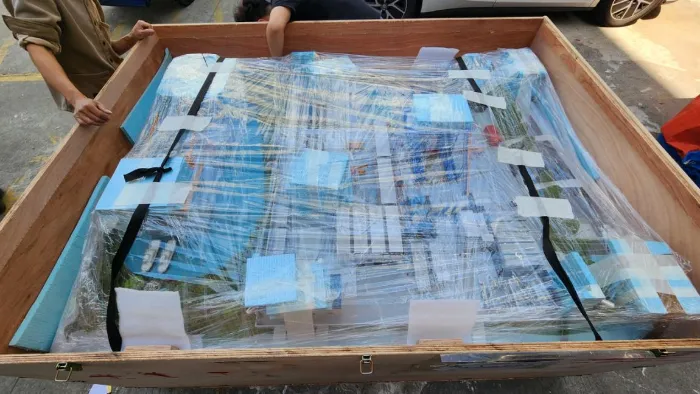
Large wooden export shipping crate held by workers, containing a heavily shrink-wrapped architectural model package secured with black ratchet straps, blue foam padding and white tape layers – professional heavy-duty custom packaging for safe transport
Custom packaging

Protective Materials

Sensitive components such as:

cranes

pipelines

industrial equipment

landscape elements

lighting fixtures

are individually protected using shock-absorbing materials.

These materials may include:

high-density foam

anti-vibration protective padding

bubble protection layers

soft wrapping materials

Each element is secured to prevent movement during transportation.

Custom Wooden Shipping Crates

Large model modules are typically placed inside custom-built wooden shipping crates.

These crates are designed to:

absorb impact during shipping

prevent movement inside the box

protect the model from external pressure

Each crate is labeled clearly so that components can be easily identified during installation.
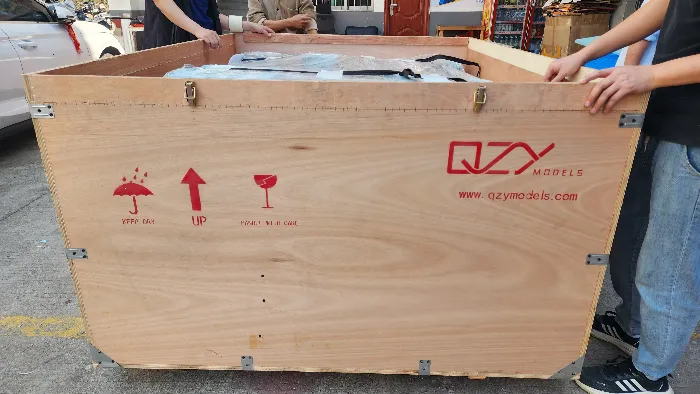
Large plywood export shipping crate with red international handling symbols (fragile, this way up, keep dry), branded QZY MODELS and www.qzymodels.com, held by workers on outdoor pavement – professional heavy-duty wooden packaging
Custom wooden Crate


Simplified Electrical Systems for Model Installation

Many architectural and industrial models include integrated lighting systems to enhance visual presentation.

Traditional models require complicated wiring during installation. This process can be time-consuming and error-prone.

To solve this problem, many modern models now use Quick Connection Systems.
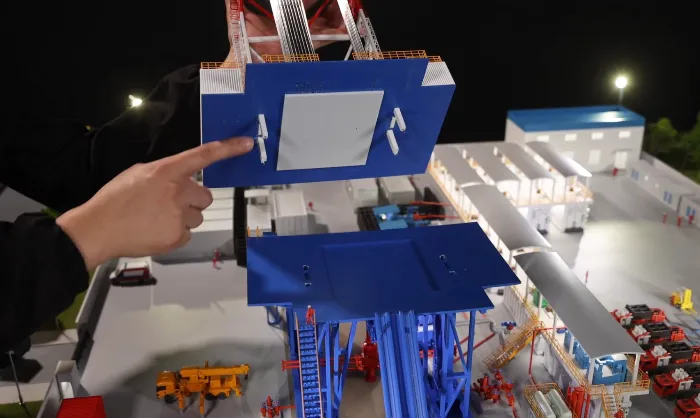
Hand demonstrating quick-connection modular blue platform section with white latches being attached to detailed drilling rig scale model – precise tool-free assembly of industrial platform module on illuminated oil & gas exhibition model
Quick-connection design


What Is a Quick Connection System?

A quick connection system allows electrical power to pass automatically when modules are connected.

Instead of manually wiring each light component, the system uses:

plug connectors

magnetic connectors

contact-based electrical interfaces

Benefits of Quick Connection Systems

dramatically faster installation

reduced risk of wiring mistakes

easier disassembly for transportation

reliable electrical performance

This approach is particularly useful for industrial models, exhibition models, and large commercial display models.
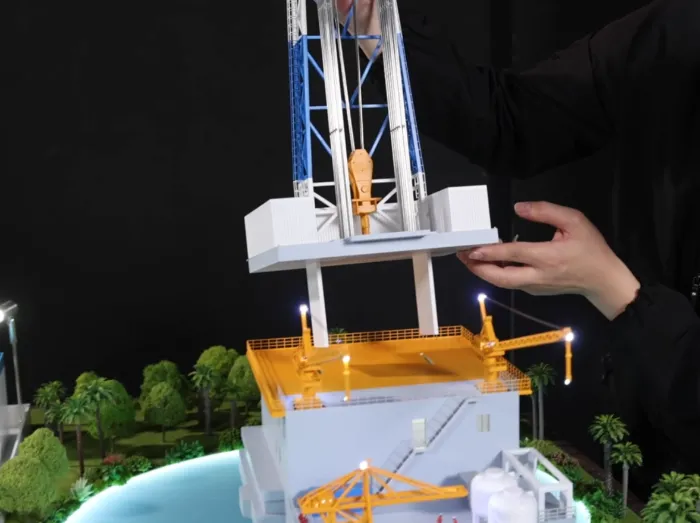
Hands demonstrating easy plug-in lighting connection on detailed offshore drilling rig scale model: attaching illuminated blue-white tower section with glowing LED lights onto yellow-crane platform base – modular lighted industrial model assembly
Easy Lighting Connection


Structural Optimization to Reduce Shipping Costs

Large architectural models can become extremely expensive to transport if the structure is not optimized for shipping.

Air cargo and international freight companies calculate prices based on volume and weight. Oversized models can quickly multiply transportation costs.

Professional model makers therefore optimize structures during the design phase.

Examples of Structural Optimization

Common techniques include:

Foldable model bases

Large base structures can be designed to fold into compact sections, significantly reducing packaging volume.
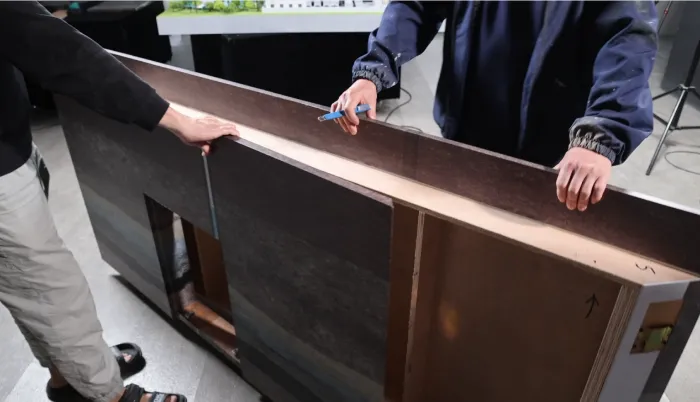
Two workers assembling large foldable plywood display base with dark wood-grain finish, one marking precise alignment with blue marker while holding edges – modular platform with cutouts and orientation arrow for architectural and industrial scale models
Foldable Base Structure


Detachable vertical elements

Tall structures such as:

drilling towers

cranes

observation towers

High rises

can be designed to detach from the base for safe transport.
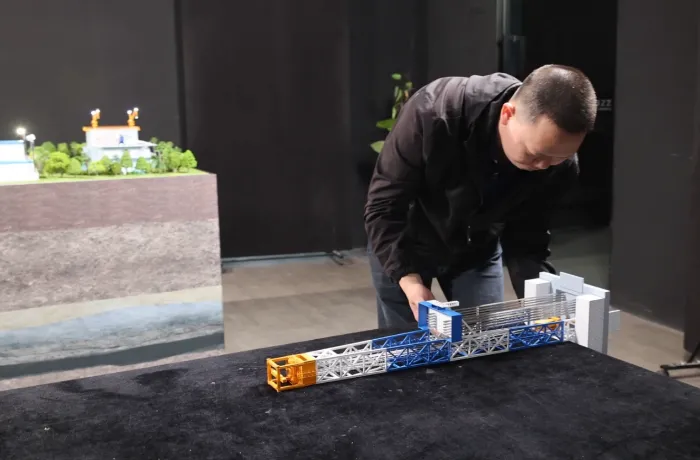
Man assembling detachable drilling rig scale model on black display table, showing modular blue-white-orange metal truss structure with platform sections – professional industrial engineering model demonstration
Detachable Drilling Rig

Benefits of Structural Optimization

lower international shipping costs

easier handling and loading

improved transport safety

convenient reinstallation for future use

This design approach is ideal for models used in international exhibitions, investment presentations, and traveling displays.

Portable Architectural Models (Travel Models)

In addition to large exhibition models, many architecture firms and developers require portable architectural models for presentations.

These are commonly known as Travel Models.

Travel models are specifically designed for frequent transportation between cities or countries.

Who Uses Travel Models?

Travel models are widely used by:

architecture firms

urban planning consultants

real estate developers

investment promotion teams

exhibition presenters

These teams often present projects in multiple locations worldwide.

Key Features of Travel Models

Travel models focus on portability and efficiency:

lightweight structures

modular components

quick assembly systems

protective travel cases

In some cases, the model can even be transported as standard airline checked baggage, reducing logistics complexity and customs costs.

Aluminium Travel Cases for Model Transportation

Portable architectural models are typically transported using custom aluminium travel cases.

Compared to wooden crates, aluminium cases offer several advantages.
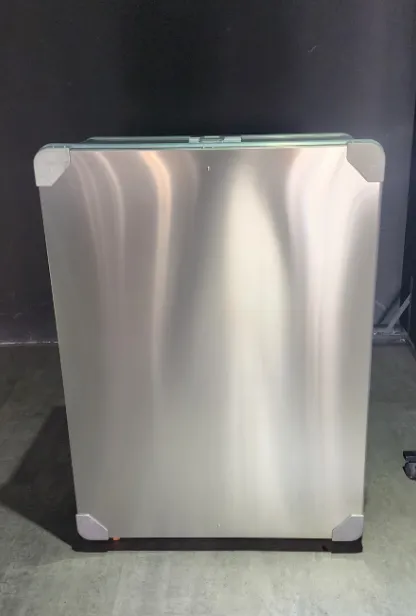
Polished silver stainless steel square enclosure with brushed metal finish, white protective corner guards on all four corners, standing on dark floor – industrial control box or server cabinet
Aluminium Travel Cases


Benefits of Aluminium Transport Cases

strong and impact resistant

lightweight construction

integrated handles and wheels

easy mobility in airports and exhibition venues

The clean metallic finish also provides a professional and high-end appearance, making the cases suitable for international travel and exhibitions.
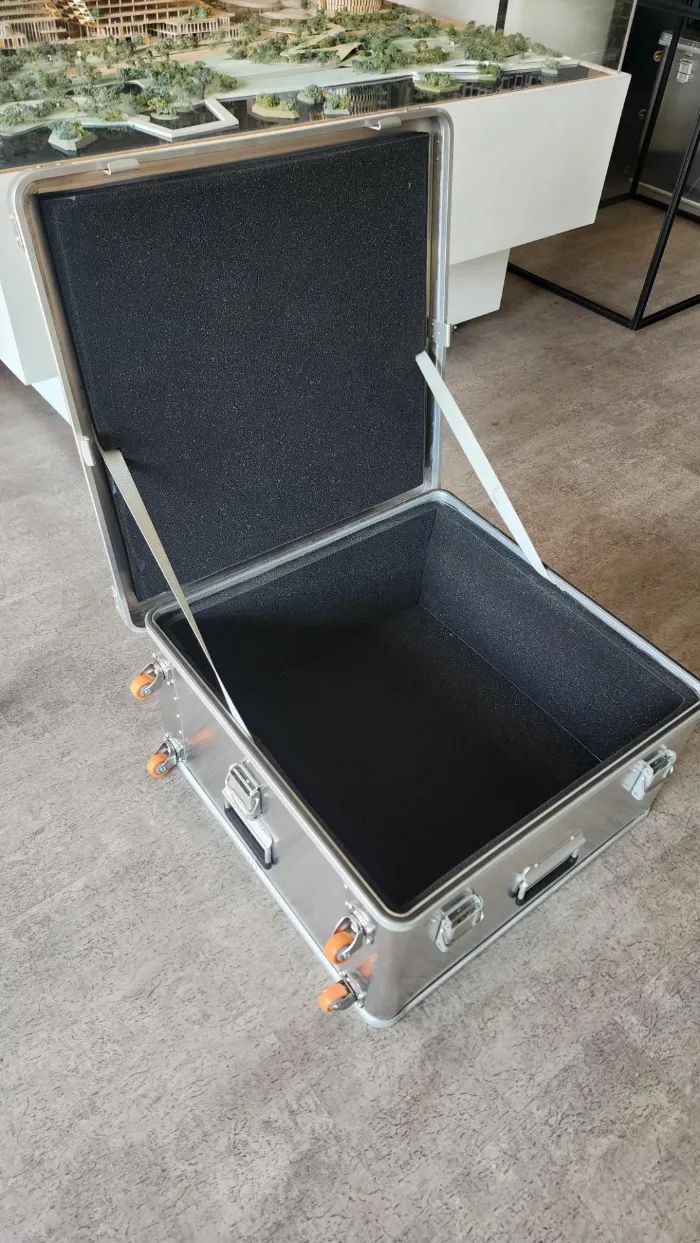
Open aluminum flight case with silver metal frame, black foam-padded interior, orange caster wheels, open lid supported by strap, displayed on gray floor in architectural model studio with large building scale models in background

Custom Aluminium Cases

Custom Foam Protection for Model Components

Inside transport cases, model components are protected using precision-cut foam inserts.

These foam structures are custom designed to match the exact shape of each component.

This ensures that every element remains securely fixed during transportation.

Advantages of Custom Foam Inserts

prevents components from colliding

absorbs vibration and impact

keeps components organized

speeds up unpacking and assembly

This system allows models to withstand multiple international shipments without damage.
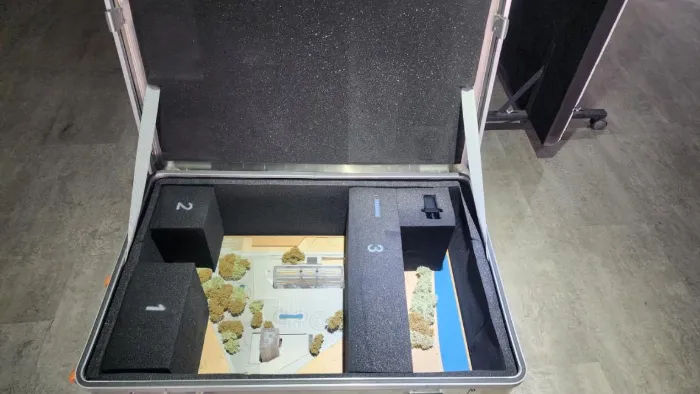
Custom black foam insert inside open aluminum flight case with numbered die-cut compartments (1, 2, 3) precisely holding a detailed architectural scale model featuring miniature trees, bridge structure and landscape base – professional model protection

Custom Foam Protection

Global Architectural Model Shipping Solutions

Transporting architectural models internationally requires a combination of design expertise, packaging engineering, and logistics experience.

{{image: world map with shipping routes, cargo plane and truck icons, and labeled wooden crates moving between continents}}

By integrating modular design, optimized structures, and professional packaging systems, modern model makers can ensure that even complex models are delivered safely worldwide.

For clients, this means a model is not only a beautiful presentation piece but also a durable, transportable, and reusable professional tool.

About QZY Models

QZY MODELS is a professional model-making company specializing in architectural scale models, industrial models, and urban planning models for global clients.

With more than 20 years of experience, the team provides complete services including:

architectural model design

model fabrication

international packaging and shipping

on-site installation support

These integrated services ensure that every model can be safely transported and efficiently presented anywhere in the world.

www.qzymodels.com

[email protected]

Share:

More Articles

Our Service

  • Make Architectural Models

    Our team of architectural model builders can assist you with dynamic displays that fit the scope of your project with solutions at large and small scales.

  • Make Urban Models

    Urban models are mathematical representations used to simulate and analyze urban development, transportation, and land use patterns for urban planning and policy decision-making.

  • Make Landscape Models

    Landscape models aid in regional, park, and urban landscape planning. We specialize in crafting professional landscape models tailored to your needs.

Send Us A Message

Add Your Heading Text Here

We pride ourselves on our Global Model Shipping and Installation Services, which ensure that your models are delivered safely to any city around the world. With over 20 years of experience in this field, we have honed our processes to provide a seamless and efficient service tailored to meet the specific needs of each project.

Comprehensive Shipping Solutions

Our extensive experience encompasses every aspect of the shipping process, including:

Expert Packaging: We utilize specialized packaging techniques to protect models during transit, ensuring they arrive in perfect condition. Our packaging is designed to meet the requirements of various transportation methods and the specific dimensions of each model.

Transportation Logistics: We carefully select transportation methods based on the nature of the model and its destination, considering factors such as budget, timing, and the most efficient route. We ensure that transportation aligns with the packaging size and requirements for safe handling.

Customs Compliance: Our team is well-versed in the import/export regulations of different countries. We handle all necessary documentation to facilitate smooth customs clearance and compliance with local laws, mitigating any potential delays or complications.

Climate Adaptability: We evaluate whether models are suitable for local climate conditions, ensuring that materials and finishes can withstand environmental factors in the destination city.

Professional Installation and Maintenance

In addition to shipping, we offer professional installation services that guarantee your models are set up correctly and functionally in their intended locations. We also provide ongoing support and maintenance, regardless of whether the models were produced by us or other manufacturers:

Thorough Inspection: We conduct comprehensive inspections of models upon arrival to ensure they meet quality standards and are free of any damage.

Maintenance and Repair: Our skilled technicians are equipped to perform routine maintenance, repairs, and refurbishments on models, acting as the “family doctor” for your models. No matter the issue, we are committed to restoring them to their best condition.

Adaptability to Local Practices: We take into account regional differences in model upkeep and care, providing tailored recommendations for maintenance based on local practices and environmental considerations.

Your Trusted Partner

At QZY Models, we understand that every detail matters in the shipping and installation process. Our commitment to quality service means we never shy away from challenges—no matter how complex the model or the issues at hand, we are here to ensure that your models look their best and perform optimally.

With QZY Models, you can rest assured that your models are in expert hands, backed by decades of experience and a dedication to excellence.

We offer comprehensive 3D printing services, including file design optimization, physical model printing, and post-processing services such as sanding and painting. Our 3D printing capabilities allow us to produce detailed and accurate models quickly and efficiently, with a wide variety of materials to meet the specific needs of your project.

Advantages of 3D Printing

Complex Shapes: One of the key benefits of 3D printing is its ability to create highly complex and intricate geometries that would be difficult or impossible to achieve with traditional manufacturing methods. This makes it ideal for producing intricate architectural models, sculptures, and industrial components.

Fast Turnaround: 3D printing can significantly reduce production time. Once the design is finalized, we can quickly move from concept to finished model, providing faster delivery compared to other techniques like CNC machining or handcrafting.

Cost-Effective: For small runs or prototypes, 3D printing is generally more cost-effective than other manufacturing methods, especially when dealing with complex designs that would require expensive molds or tooling in traditional fabrication.

Versatility of Materials: We offer a wide range of materials to suit different needs, including transparent, semi-transparent, and white resins, as well as ceramics, metals, red wax, and nylon. Each material has its unique properties, such as varying degrees of hardness, flexibility, and durability, providing greater flexibility in model creation.

Material Options: 3D printing supports a variety of materials, including:

Transparent and semi-transparent resins

Ceramics for more rigid and heat-resistant models

Metal for industrial-grade models

Nylon for durable and flexible prints

Red Wax for precision casting molds

Other Specialty Materials like white resin for detailed models

Disadvantages of 3D Printing

While 3D printing has many benefits, it does come with certain limitations:

Material Degradation: Some materials, especially those used for prototypes, can be prone to discoloration or deformation over time, especially when exposed to heat, light, or humidity.

Limited Surface Finishing: Certain materials used in 3D printing do not accept paint or other finishing treatments well, which can limit their use for final presentation models without additional post-processing.

Lower Precision: Although 3D printing is highly accurate for most applications, it has slightly lower precision compared to laser cutting or CNC machining, particularly in terms of fine details and surface smoothness.

Post-Processing Required: Most 3D-printed models require additional work after printing, such as sanding, polishing, or painting, to achieve the desired finish and smooth out imperfections.

Applications of 3D Printing

Our 3D printing services can be applied across various industries, including:

Architectural models

Industrial prototyping

Product design

Medical devices

Creative sculptures

Exhibition pieces

At QZY Models, we leverage the flexibility and efficiency of 3D printing to provide high-quality models tailored to your specific requirements. Our team can also assist in optimizing your 3D printing files for better results, ensuring the final product meets your design goals.

Our core expertise lies in crafting Custom High-end Architectural Models that transcend conventional techniques, materials, and forms. We specialize in delivering unique, tailored solutions that align with the creative visions of our clients. Our approach is driven by a deep understanding of the design intent, allowing us to create models that go beyond mere representation—they capture the essence and meaning of the architecture itself.

We believe that every design holds an underlying narrative, and our skilled team excels at interpreting and expressing this narrative through innovative modeling techniques. By closely collaborating with architects and designers, we ensure that the final model not only serves as a visualization tool but also acts as a source of inspiration, revealing new perspectives and highlighting the elegance and beauty that might otherwise remain unseen.

Our custom models are designed to amplify the architectural impact, bringing out the individuality, tension, and personality of each project. Whether you require a model for a cutting-edge skyscraper, a cultural landmark, or a visionary urban development, we are committed to delivering solutions that push creative boundaries. Our models are more than just physical representations—they are works of art that communicate the spirit of the design.

By utilizing advanced materials, state-of-the-art technology, and unconventional craftsmanship, we ensure that each model is meticulously crafted to meet the highest standards of quality and precision. Our innovative approach allows us to explore new methods and materials that best reflect the design’s unique character and purpose, providing clients with models that are both functional and aesthetically captivating.

Our expertise goes beyond architectural models. We offer comprehensive fabrication services for a wide range of physical models tailored to various industries and purposes. Our team specializes in creating precise, scaled-down models that bring concepts and designs to life, providing visual clarity and technical accuracy for diverse applications. These models are valuable tools for presentations, demonstrations, prototypes, and exhibitions. Our model categories include, but are not limited to:

Landscape Models: Capture outdoor environments with detailed representations of parks, green spaces, urban planning, and natural features.

Interior Design Models: Showcasing interior decoration designs, sectional structure designs, and spatial designs, providing detailed displays of interior environments.

Signage & Sculptures: Custom-made models for signage, artistic sculptures, and branding elements.

Industrial Models: Scaled-down versions of industrial equipment, machinery, and production lines for presentations, training, and technical demonstrations.

Mechanical & Engineering Models: Represent complex mechanical systems and construction processes in an easy-to-understand format.

Gift & Promotional Models: Unique and creative physical models for corporate gifts, promotional items, and special events.

Medical Device Models: Highly detailed replicas of medical equipment and devices used for demonstrations, training, and exhibitions.

Energy Equipment Models: Models of energy infrastructure, including renewable energy setups, power plants, and equipment, for industrial use.

Transportation Infrastructure Models: Scaled models of transport systems, including vehicles, stations, airports, and railway facilities.

Topographic & Terrain Models: Detailed geographic and topographic models for land development, environmental studies, and educational purposes.

Hydraulic & Water Facility Models: Representations of water management systems, including dams, water treatment plants, and irrigation systems.

Military Models: Models of military equipment, vehicles, aircraft, and naval vessels for research, education, and exhibitions.

Engineering Vehicles, Aircraft & Ships: Scaled replicas of construction vehicles, aircraft, and ships used in industrial and educational displays.

Figurine & Animal Sculptures: Realistic and stylized models of humans, animals, or other characters for museums, exhibitions, and creative displays.

Whether you need a detailed representation of industrial equipment, a landscape design, or a precise medical device model, we ensure each project is custom-tailored to match your exact specifications. Using advanced fabrication techniques, including 3D printing, CNC machining, and laser cutting, we deliver models that meet the highest standards of quality and accuracy.

Our models are designed to support a variety of industries, providing practical solutions for demonstration, training, project development, and marketing. We work closely with our clients to ensure every detail is captured, from material selection to scaling and finishing, creating physical models that are as functional as they are visually impressive. 

我们提供全面的设计解决方案,通过精湛的工艺和尖端技术将您的愿景变为现实。我们的团队擅长制作定制模型设计,以满足每个项目的独特需求,无论是建筑展示、城市规划、展览还是开发展示。

专业工艺:我们经验丰富的专业人员将您的想法转化为细致的模型,确保每个项目的精确度和质量。

材料灵活性:我们提供多种材料选择,包括木材、丙烯酸和 3D 打印组件,以适应各种建筑风格和设计偏好。

创新技术:利用先进的 3D 打印和激光切割技术,我们确保每个模型的细节复杂而精确,即使是最复杂的设计也能提供高质量的结果。

项目类型的多样性:无论是住宅建筑、商业综合体、城市开发还是展览模型,我们都会调整方法来满足每个项目的独特需求。

我们对创新和质量的承诺确保我们设计的每个模型都与您的愿景完美契合,使您的项目脱颖而出并留下持久的印象。