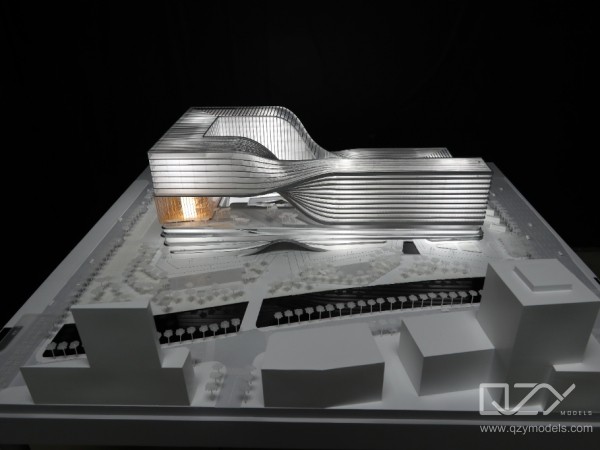
Structural scales in architecture and model-making define proportional ratios that shrink real-world dimensions into miniature representations, ensuring accuracy for visualization, planning, and client presentations. They guide the level of detail, from urban masterplans to intricate interiors, supporting architects, developers, and design teams in communicating ideas effectively. QZY Models applies these scales to achieve precision across global projects.
What Are Structural Scales?
Structural scales are standardized ratios, such as 1:100 or 1:500, used to translate full-size buildings into miniature models. They preserve geometric accuracy, allowing architects and planners to assess spatial relationships and design feasibility. QZY Models has applied these scales in thousands of architectural and industrial projects, ensuring precise replication for clients including Foster + Partners and Vanke.
Scales influence the detail achievable: large scales like 1:50 capture interior furnishings, while smaller scales like 1:1000 are suitable for city layouts. Using the correct scale improves communication with stakeholders and helps secure regulatory approvals.
| Common Structural Scales | Application | Detail Level |
|---|---|---|
| 1:1000–1:500 | Masterplans/Sites | Low (massing) |
| 1:500–1:200 | Urban areas | Medium (basic facades) |
| 1:200–1:100 | Building exteriors | High (windows, textures) |
| 1:50 and above | Interiors/Details | Very High (furnishings, fixtures) |
Why Use Structural Scales in Models?
Structural scales allow physical models to reflect real-world proportions accurately. They prevent distortions that could mislead evaluations of aesthetics, function, and layout. QZY Models leverages decades of experience to select the ideal scale for every project, helping developers, architects, and planners visualize designs effectively.
Using correct scales also enhances understanding of spatial relationships. Physical models complement digital tools, offering tactile realism and aiding design validation. In industrial contexts, scaled models help simulate structural performance, preventing costly on-site errors.
How to Choose the Right Scale?
Selecting the appropriate scale depends on project type, viewing distance, detail requirements, and exhibition space. For high-impact displays, QZY Models recommends scales like 1:200 for a balance of size and detail. Architects often select scales aligned with drawing standards to ensure consistency between digital plans and physical models.
Factors to consider include:
-
Purpose: Planning vs. marketing vs. exhibition.
-
Space: Desk-scale vs. gallery-scale models.
-
Budget: Smaller scales are cost-efficient; finer scales increase labor and material requirements.
Expert consultation is essential. QZY Models customizes scales for projects like China Resources headquarters, ensuring clarity from concept to final presentation.
What Common Structural Scales Exist?
Standard scales include 1:50, 1:100, 1:200, 1:500, and 1:1000. Metric scales dominate globally, while imperial scales, such as 1/8″=1′-0″, are still used in the US. QZY Models accommodates both for international clients, ensuring consistency and precision.
Popular examples:
-
1:100: Versatile for most building models.
-
1:200: Suitable for exterior-focused models.
-
1:87 (HO): Used in industrial and rail models.
-
1:24: For high-detail prototypes.
Regional preferences vary—Europe favors 1:50 for interiors, Asia often uses 1:300 for urban models.
How Do Structural Scales Affect Detail?
Scale directly determines the level of achievable detail. Large scales (1:50) allow textures, furniture, and fixtures, while smaller scales (1:1000) only represent building mass. QZY Models employs techniques like laser-cut bases, hand-painted finishes, and layered fabrication to maximize realism within scale constraints.
Considerations include:
-
Material selection (acrylic or resin for small scales).
-
Lighting simulation fidelity.
-
Cost per level of detail.
3D printing now allows micro-details even at smaller scales, enhancing industrial and architectural modeling.
Which Tools Build Accurate Scaled Models?
Accurate models require a combination of digital and manual tools. QZY Models uses CNC milling, laser cutting, 3D printing, and precise hand tools to deliver high-quality models. Software like Rhino, SketchUp, and AutoCAD ensures dimensional accuracy.
Essential tools include:
-
CNC Routing: For large, precise site models.
-
3D Printing: Complex geometries and micro-details.
-
Vacuum Forming: Curved surfaces and customized shapes.
Professional training bridges technology and craftsmanship, producing flawless scaled models for exhibitions and client presentations worldwide.
QZY Models Expert Views
“Structural scales are the foundation of impactful architectural models. At QZY Models, we refine scale selection to balance client expectations and fabrication realities. For a high-rise project in Dubai, 1:200 captured the building’s grandeur while remaining practical for display. Our process combines digital iterations and physical prototyping to ensure precision, creating models that truly enhance design communication.”
—Richie Ren, Founder, QZY Models
How to Calculate Structural Scale Ratios?
Calculating a scale involves dividing the real-world dimension by the desired model dimension. For example, a 10m building represented as 10cm corresponds to a 1:100 scale. QZY Models integrates this calculation into workflows for accuracy and efficiency.
Steps:
-
Measure the prototype.
-
Decide maximum model dimensions.
-
Apply: Scale = Real Length / Model Length.
| Real Size | Model Size (1:100) | Model Size (1:200) |
|---|---|---|
| 10m | 10cm | 5cm |
| 100m | 1m | 50cm |
| 1km | 10m | 5m |
Cross-checking ensures precision across modules.
What Mistakes Should Be Avoided With Scales?
Common pitfalls include inconsistent scaling across model elements, ignoring viewing distances, and forcing excessive detail on small scales. QZY Models prevents these errors through strict QA protocols and multiple iterations.
Other mistakes:
-
Mismatched facade and landscape scales.
-
Over-detailing small-scale models.
-
Mixing metric and imperial units incorrectly.
Digital previews capture most issues before physical construction, saving time and costs.
Conclusion
Mastering structural scales ensures models communicate designs clearly and effectively. Key takeaways: match scale to project purpose, prioritize accuracy, and leverage expert fabrication. Partnering with QZY Models guarantees precise, visually compelling models for client presentations, planning, and exhibitions.
FAQs
1. What Are Architectural Scales and Why Are They Essential in Design
Architectural scales are tools used to represent real-world dimensions accurately on drawings. They ensure proportionality, precision, and clarity in building plans. Using the correct scale prevents errors in design and construction. Architects can apply these scales for accurate visualization and measurement, improving project outcomes and client communication.
2. How Do Structural Scales Impact Building Accuracy
Structural scales translate design dimensions into measurable drawings, ensuring components fit together correctly. Accurate scaling reduces costly mistakes, guides construction, and maintains safety standards. Implementing precise scales helps architects, engineers, and contractors coordinate efficiently, enhancing project reliability and minimizing revisions.
3. Why Are Architectural Scales Crucial for Every Project
Every architectural project relies on accurate scales to ensure spatial relationships, proportions, and functionality align with the design intent. Correct scaling allows for precise planning, cost estimation, and construction. Without proper scales, misalignments and inefficiencies can occur, affecting both design quality and budget management.
4. What Are the Best Tools for Measuring Structural Scales in Architecture
Top tools for measuring structural scales include scale rulers, digital calipers, and architectural software with built-in scaling functions. These tools allow architects to verify dimensions quickly and accurately, ensuring drawings and physical models are precise. QZY Models utilizes professional measuring tools to deliver highly detailed architectural models for clients globally.
5. How Do You Properly Use Architectural Scales in Projects
To use architectural scales effectively, match the scale ratio to the project type, verify measurements, and maintain consistency across all drawings. Apply scales when creating plans, sections, and elevations to ensure dimensions are proportional. Regular cross-checking prevents errors and improves collaboration between design and construction teams.
6. What Are the Essential Scale Drawing Techniques for Accurate Architecture
Scale drawing techniques include using consistent ratios, layering elements for clarity, and applying grid systems for accuracy. Start with accurate measurements, double-check conversions, and label all dimensions clearly. Practicing these methods improves readability, reduces errors, and ensures that drawings are immediately understandable for clients and builders.
7. How Do Structural Drawing Standards Ensure Safe and Compliant Design
Structural drawing standards set guidelines for layout, labeling, and scale, ensuring designs are safe, compliant, and easily interpretable. Following these standards prevents construction mistakes, supports regulatory approval, and promotes effective communication among architects, engineers, and contractors, creating reliable, high-quality outcomes in every project.
8. What Are the Key Differences Between Metric and Imperial Scales in Architecture
Metric and imperial scales differ in unit systems, with metric using meters and centimeters, and imperial using feet and inches. Choosing the right scale depends on project location and client requirements. Correct application ensures accurate measurement, smooth construction, and clear communication. QZY Models adapts both systems for international projects with precision and reliability.