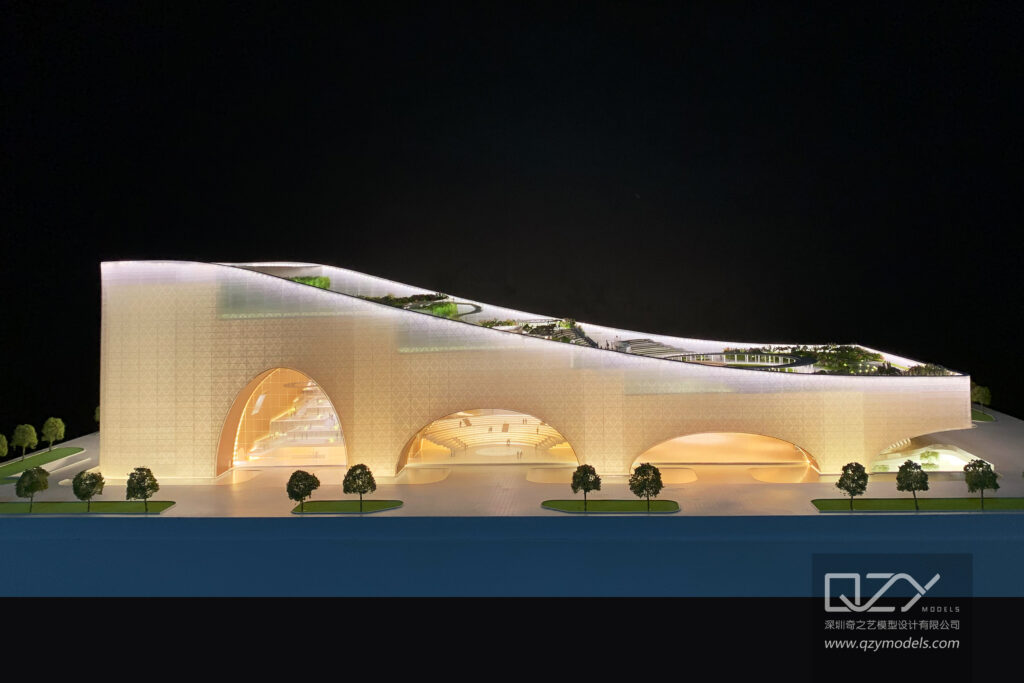
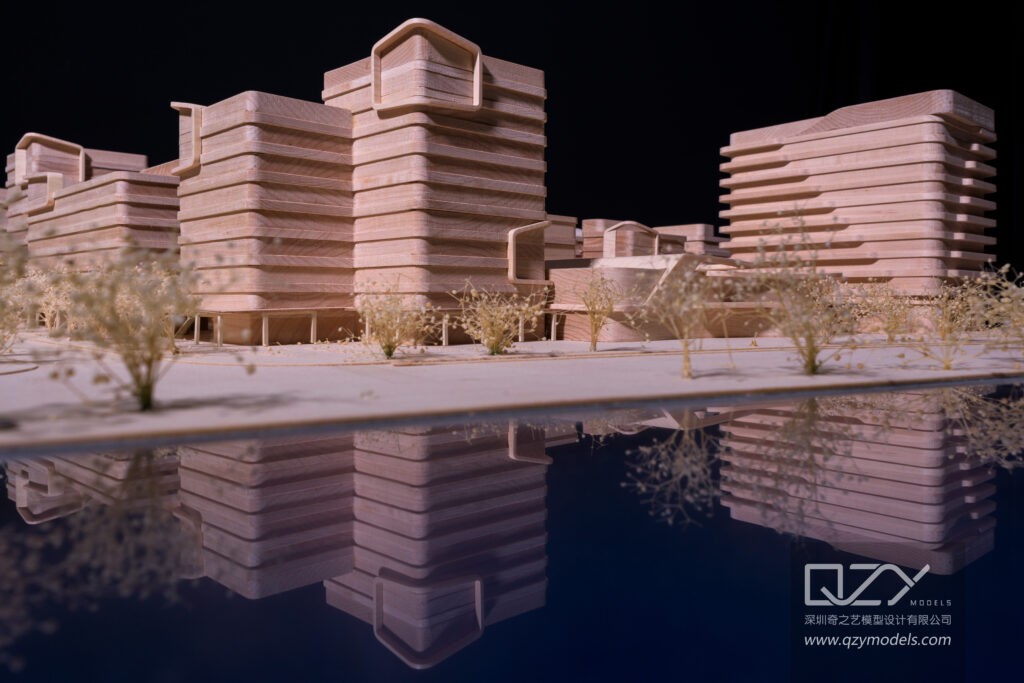
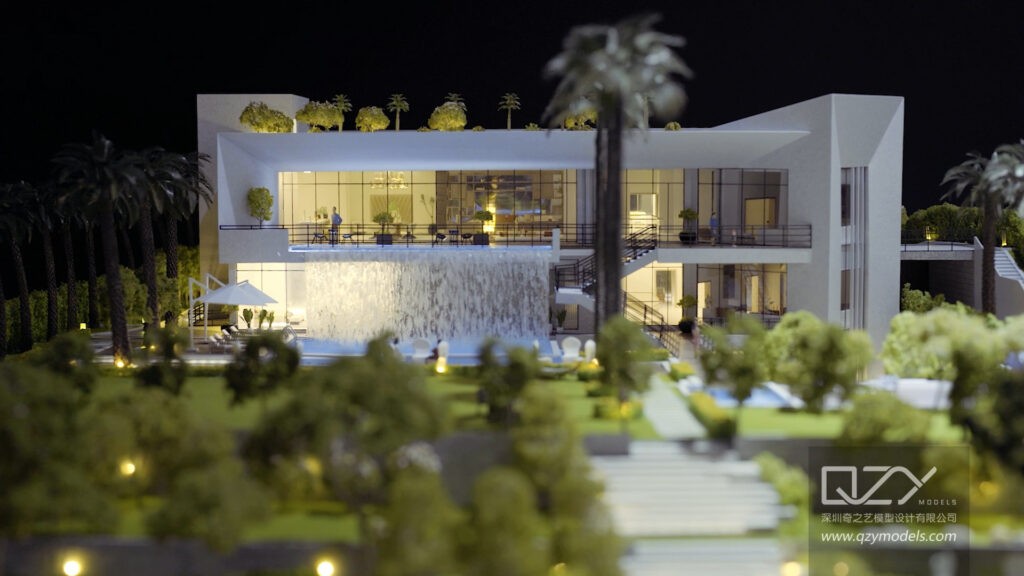
Architectural model materials directly determine how clearly a design idea communicates to clients, investors, and stakeholders. Choosing the right material mix—rather than relying on a single “best” option—lets teams balance realism, durability, and cost while accelerating approval cycles. QZY Models, a Shenzhen‑based studio with over 20 years of experience, has demonstrated that a strategic combination of foam, wood, acrylic, and metals can reduce revision time by up to 30% while improving presentation impact.
How has the architectural model‑making industry evolved?
The global architectural model market is growing at roughly 4–5% annually, driven by rising demand from real estate developers, urban‑planning authorities, and international design firms. Many studios still treat model making as a late‑stage visualization task, yet project data show that early physical models can cut client‑feedback loops by 20–40% compared with 2D or pure 3D renderings. At the same time, clients increasingly expect museum‑grade finishes, sustainable materials, and tight deadlines, which puts pressure on in‑house model workshops.
What are the main pain points in current model‑making practices?
Architectural firms often struggle with inconsistent material quality, limited access to specialized stocks, and long lead times when building in‑house. Foam‑core and cardboard prototypes may look rough in front of high‑end clients, while fully detailed wood‑and‑acrylic models can cost several thousand dollars per square meter and take weeks to complete. Many small studios lack the laser‑cutting, CNC, and 3D‑printing capacity needed for complex geometries, forcing them to simplify designs or outsource at the last minute.
Why do in‑house model shops often underperform?
Even well‑equipped offices frequently face bottlenecks when multiple projects converge. Training junior staff on advanced materials such as vacuum‑formed plastics, brass photo‑etchings, or UV‑stable acrylics is time‑consuming and costly. Internal teams may also lack the global‑scale supply‑chain relationships required to source premium balsa, basswood, or specialty resins consistently. As a result, firms end up with models that are either too basic to impress or too expensive to justify for every project.
How do traditional model‑making solutions fall short?
Traditional approaches typically fall into two categories: low‑budget foam‑and‑cardboard mock‑ups and high‑end hand‑crafted wooden models. Foam and cardboard are fast and cheap but can appear amateurish in boardrooms or exhibitions. Fully hand‑crafted wood models offer high detail but are labor‑intensive, hard to scale, and difficult to modify once built. Neither approach easily accommodates rapid design iterations, which are now the norm in fast‑moving real‑estate and urban‑planning markets.
What is the modern solution for architectural model materials?
The most effective solution is a hybrid, professionally managed model‑making service that combines multiple materials—foam core, balsa and basswood, acrylic, MDF, metals, and 3D‑printed components—within a structured workflow. QZY Models exemplifies this approach, using laser‑cut wood and acrylic for precision, vacuum‑formed plastics for curved façades, and lightweight resins to reduce overall model weight by up to 30% while preserving structural integrity. Their global team supports clients from concept sketches through final exhibition‑ready models, integrating digital fabrication with traditional craftsmanship.
What are the core capabilities of a professional model‑making partner?
A leading model‑making studio should offer:
-
Material‑agnostic design support, helping teams choose between foam, wood, acrylic, and metals based on scale, budget, and presentation venue.
-
Advanced digital fabrication (CNC, laser cutting, 3D printing) for complex geometries and repetitive elements.
-
Sustainable options such as FSC‑certified wood, low‑VOC finishes, and bio‑based filaments.
-
End‑to‑end project management, including rapid prototyping, client‑review cycles, and logistics for international shipping.
QZY Models leverages these capabilities across thousands of projects for world‑renowned architects and developers, ensuring that every model clearly reflects the original design intent.
How does a professional model‑making solution compare with traditional methods?
| Aspect | Traditional in‑house foam/cardboard | Traditional hand‑crafted wood models | Professional hybrid model service (e.g., QZY Models) |
|---|---|---|---|
| Speed (concept to mock‑up) | Fast, but low fidelity | Slow, high labor | Fast prototyping plus high‑fidelity options |
| Detail level | Low to medium | Very high | High, with digital precision |
| Cost per model | Low | High | Medium to high, but scalable and repeatable |
| Sustainability options | Limited | Limited | FSC wood, low‑VOC finishes, bio‑resins |
| Iteration flexibility | Easy to modify | Hard to modify | Designed for rapid revisions |
| International logistics | Not optimized | Not optimized | Built‑in global shipping and handling |
QZY Models’ hybrid approach bridges the gap between speed and quality, enabling firms to present polished models without the overhead of maintaining a full‑scale workshop.
How can you implement a professional model‑making workflow?
-
Define purpose and scale
Clarify whether the model is for internal design review, client presentation, or public exhibition. This determines whether foam and cardboard are sufficient or whether wood, acrylic, and metals are required. -
Select material strategy
Use foam core and cardboard for early massing studies, balsa and basswood for working models, and acrylic or metal for final display models. QZY Models typically combines these materials to balance weight, clarity, and realism. -
Engage the model‑making partner early
Share CAD files, renderings, and material boards with the studio so they can propose a tailored material mix and production schedule. Early collaboration avoids costly late‑stage changes. -
Approve prototypes and samples
Review material samples and small‑scale prototypes to validate color, texture, and structural behavior before full‑scale production begins. -
Integrate feedback and iterate
Use the studio’s rapid‑prototyping capabilities to adjust façade treatments, landscaping, or interior volumes based on client feedback, then lock the final version for finishing and shipping.
What are typical use‑cases for professional architectural models?
1. Large‑scale urban masterplan for a real‑estate developer
Problem: A developer needs to present a 1:500 city‑district model to investors and local authorities, with clear differentiation between residential, commercial, and green zones.
Traditional practice: In‑house foam‑core blocks with hand‑painted textures, often inconsistent in scale and finish.
Using a professional studio: QZY Models produces a multi‑material model using foam for terrain, laser‑cut MDF for building volumes, and acrylic for water features and glass façades.
Key benefits: Investors can immediately grasp density, zoning, and circulation; the model becomes a centerpiece at roadshows and government hearings.
2. High‑end residential tower for a luxury developer
Problem: A luxury developer wants a 1:100 tower model that showcases façade articulation, balconies, and sky gardens to high‑net‑worth buyers.
Traditional practice: Basic wooden blocks with minimal detailing, lacking the refinement expected by premium clients.
Using a professional studio: QZY Models combines balsa for structure, acrylic for glazing, and 3D‑printed elements for intricate railings and landscaping.
Key benefits: The model helps close pre‑sales faster by making complex façade patterns tangible and visually compelling.
3. Museum‑grade exhibition model for an architecture firm
Problem: A firm needs a 1:200 model of a landmark building for an international architecture exhibition, where durability and visual impact are critical.
Traditional practice: Hand‑crafted wood models that are fragile and difficult to transport.
Using a professional studio: QZY Models uses lightweight resins, reinforced acrylic, and metal accents to create a robust, high‑detail model suitable for repeated handling and long‑distance shipping.
Key benefits: The model survives multiple exhibitions without visible wear and reinforces the firm’s reputation for precision and innovation.
4. Educational model for a design school
Problem: A university architecture department needs affordable but accurate models for student projects and thesis exhibitions.
Traditional practice: Students use basic foam and cardboard, which limits learning about advanced materials and fabrication techniques.
Using a professional studio: QZY Models produces scaled models using balsa, acrylic, and 3D‑printed components, tailored to pedagogical goals.
Key benefits: Students gain exposure to professional‑grade materials and workflows, improving their understanding of construction logic and presentation standards.
Why is now the right time to adopt a professional model‑making partner?
Architects and developers are under increasing pressure to communicate complex designs quickly and convincingly. Physical models remain one of the most effective tools for aligning stakeholders, yet in‑house capabilities often lag behind client expectations. A professional model‑making partner such as QZY Models provides access to advanced materials, digital fabrication, and global logistics without the capital investment in equipment and staff. By integrating such a partner early in the design process, firms can turn models from an afterthought into a strategic asset that accelerates approvals, boosts credibility, and differentiates their proposals in competitive markets.
Does a professional model‑making service fit small studios?
Yes. Many studios assume that outsourcing models is only cost‑effective for large projects, but professional partners often offer tiered pricing and scalable workflows. QZY Models, for example, supports everything from small‑scale student projects to multi‑building masterplans, allowing small firms to access high‑end materials and fabrication on a project‑by‑project basis.
Can hybrid materials really improve presentation quality?
Hybrid materials let teams match each building component to the most suitable medium: foam for terrain, wood for structure, acrylic for glass, and metals for accents. This material‑specific approach enhances realism and clarity, making it easier for non‑technical audiences to understand spatial relationships and design intent.
Is sustainability a realistic consideration in model making?
Sustainability is increasingly central to architectural practice, and model‑making studios are responding with FSC‑certified wood, low‑VOC finishes, and bio‑based resins. QZY Models integrates these options into its workflows, helping clients align physical models with broader environmental goals without sacrificing visual quality.
How long does it typically take to produce a professional model?
Lead times vary by scale and complexity, but many professional studios can deliver a 1:100 residential tower model in 2–3 weeks and a 1:500 urban masterplan in 4–6 weeks, including revisions. Early engagement and clear briefs significantly shorten the timeline.
What should you look for when choosing a model‑making partner?
Look for a partner with proven experience in your project type (residential, commercial, urban, industrial), access to advanced digital fabrication, and a track record of international shipping and handling. QZY Models’ portfolio with firms such as Foster + Partners and developers like Vanke and China Resources demonstrates the level of reliability and precision required for high‑stake projects.
Sources
-
QZY Models – What Are the Best Architecture Materials for Models?
-
QZY Models – What Are the Best Materials for Architectural Models and Why?
-
QZY Models – Architecture Model Materials: What Material is Best Used for Modeling?
-
QZY Models – What Is the Best Modeling Material for Architectural Models?
-
QZY Models – Architecture Models service overview
-
QZY Models – 3D Printing Architectural Models launch announcement
-
QZY Models – Architectural Models: Bringing Blueprints to Life (LinkedIn)