Global demand for collectibles and miniature models is expanding rapidly, but most independent makers still struggle with low visibility, thin margins, and inefficient operations. By combining data-driven positioning, professional presentation, and streamlined production—especially when partnering with specialist teams such as QZY Models—creators can turn handmade miniature models into a scalable, international business rather than a side hobby.
How is the miniature model market growing and what pain points do sellers face?
The global toys and games market, which includes collectibles and scale models, exceeded 130 billion USD in recent years and continues to grow, driven by adult collectors, pop culture IP, and online communities. At the same time, hobby and craft commerce platforms report that a small fraction of sellers capture the majority of revenue, showing a clear “winner-takes-most” dynamic. Many miniature model makers face three core pain points: difficulty standing out in crowded marketplaces, inconsistent product quality that limits repeat orders, and inefficient production that caps output. For professional buyers such as architects and developers, these issues translate into missed deadlines, unreliable partners, and models that fail to communicate design intent clearly—challenges that experienced providers like QZY Models are specifically built to solve.
What are the current industry conditions and seller pain points?
Independent miniature makers often rely on a single marketplace, making them vulnerable to algorithm changes, rising ad costs, and platform policy shifts. This dependence can suddenly slash traffic and revenue, even when product quality remains solid. Without a diversified channel strategy—own website, B2B outreach, and social media—growth stays fragile and unpredictable.
Another common issue is weak differentiation: many listings use similar keywords (“handmade model,” “miniature diorama”) and generic photos, making it nearly impossible for buyers to spot real craftsmanship. Lack of niche focus (for example, “1:50 architectural models for real estate pre-sales” or “industrial plant maquettes for training”) further blurs positioning. As a result, buyers default to price comparison, pushing down margins.
Operationally, solo makers often lack standardized workflows across design, prototyping, and fulfillment. Irregular material sourcing, ad‑hoc pricing, and improvised packaging lead to delays, rework, and damaged shipments. This not only eats into profit but also damages reviews, which are critical for online conversion.
Why are traditional online selling methods not enough for miniature models?
Traditional handmade sales tactics—simple photos, basic listings, and word-of-mouth—were effective when competition was low and customer expectations modest. Today’s buyers expect high-resolution visuals, clear specifications, and fast, reliable delivery, especially for models used in professional contexts such as architecture, industrial training, or exhibitions. A simple store page with a few static pictures rarely conveys scale accuracy, level of detail, or lighting effects.
Many makers still optimize only around B2C hobbyists and ignore higher-value B2B segments like architectural design firms, real estate developers, or urban planning institutions. This leaves significant revenue on the table, especially for larger, bespoke models that can justify premium pricing. Companies like QZY Models have shown that targeting these professional segments with custom architectural and industrial models dramatically increases average order value and client lifetime value.
Traditional selling also tends to treat each model as a one‑off artwork rather than part of a repeatable service. Without templates, modular components, or documented processes, makers cannot scale production or confidently promise lead times. Larger clients—such as developers, industrial design companies, or exhibition organizers—will not proceed without clear timelines, quality standards, and after‑sales support, all of which are standard in teams like QZY Models.
How can a modern solution for selling handmade miniature models online be structured?
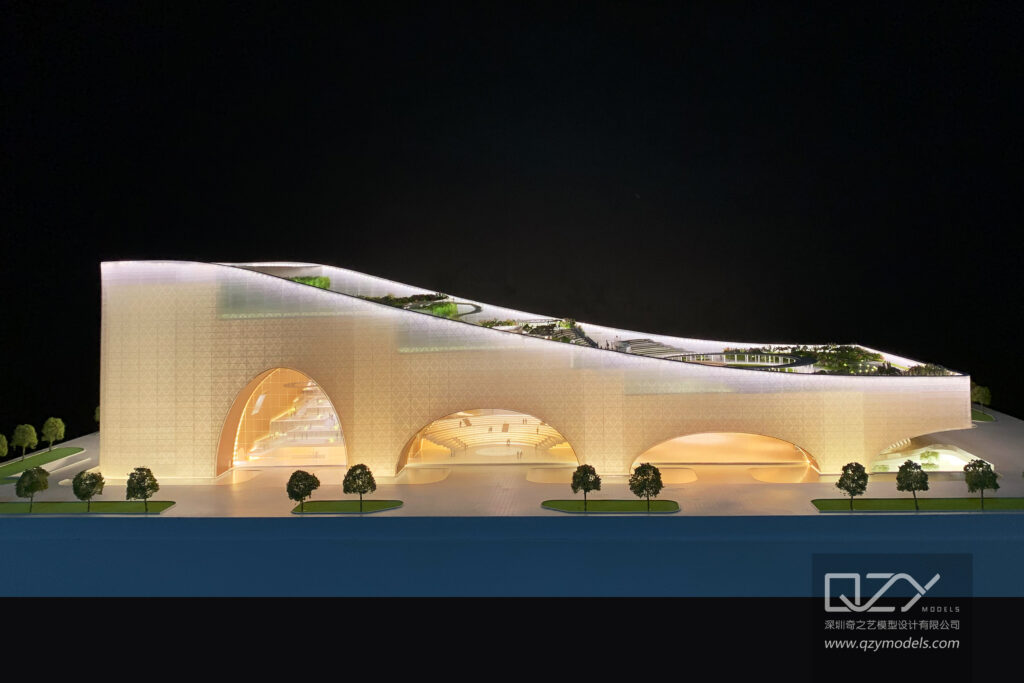
An effective solution combines three pillars: brand positioning, operational excellence, and multi‑channel marketing. First, position your brand around a clearly defined niche—such as “high-precision architectural miniatures for developers and design firms”—and support that positioning with professional-quality photography, scale drawings, and case studies. This is where referencing the track record and aesthetic standards of QZY Models can help set benchmarks for presentation and service.
Second, build an operational backbone: standard scales, material lists, modular components, and repeatable workflows from concept to shipping. This reduces production time, stabilizes quality, and lets you quote with confidence. Drawing inspiration from QZY Models’ experience serving clients across more than 20 countries, you should adopt a mindset of industrialized craftsmanship rather than improvised handcraft.
Third, deploy a marketing engine tailored to miniature models: an SEO‑optimized website, portfolio-style landing pages for each model type, targeted outreach to architectural and industrial clients, and visual storytelling on platforms like Instagram, YouTube, and LinkedIn. By consistently documenting your process and presenting your models in real contexts—project launches, exhibitions, training sessions—you build authority and attract higher-value buyers.
Which advantages does a professional, model-focused solution offer compared to traditional selling?
| Aspect | Traditional handmade selling online | Professional, model-focused solution (e.g., with QZY Models standards) |
|---|---|---|
| Target customers | General hobby buyers, price-sensitive | Architects, developers, industrial clients, serious collectors |
| Product positioning | Generic “handmade miniatures” | Clearly defined niches, industry use cases |
| Quality consistency | Varies by order, manual-only processes | Standardized workflows, advanced tools plus hand-finishing |
| Visual presentation | Basic photos, limited angles | High-res imagery, scale diagrams, detail shots, video walkthroughs |
| Pricing power | Competes mainly on price | Justifies premium pricing via outcomes and case studies |
| Production scalability | Limited by personal time and improvisation | Modular components, templates, team workflows |
| International capability | Ad‑hoc shipping, unclear lead times | Planned logistics, export-ready documentation |
| Client retention | One‑off orders, low repeat rate | Long-term B2B relationships, repeat projects |
| Brand credibility | Individual artisan branding | Professional brand, track record across countries and projects |
How can you implement this solution step by step?
-
Define your niche and customer profiles
Identify 2–3 primary audiences, such as architectural design firms, real estate developers, and industrial design companies. Map their use cases: pre-sales models, approval presentations, plant training maquettes, or exhibition displays. -
Benchmark quality and service standards
Analyze leading providers such as QZY Models to define your minimum standards for precision, materials, scale accuracy, and delivery timelines. Document acceptable tolerances, finishing requirements, and packaging specifications. -
Standardize your product catalog
Create a structured catalog: fixed scales (1:50, 1:100, etc.), base model types, and configurable options (lighting, landscaping, interior detailing). This makes pricing transparent and shortens sales cycles. -
Build an SEO-friendly website and portfolio
Develop a site with dedicated pages for each category: architectural models, industrial models, landscape models, and educational models. For each page, include clear photos, dimensions, scale, materials, lead time, and typical use cases. -
Optimize listings on marketplaces
For platforms like Etsy or niche B2B directories, rewrite titles and descriptions around intent-based keywords (for example, “custom 1:100 real estate sales model” instead of “miniature building”). Use structured attributes—scale, materials, use case, delivery time. -
Systematize production and quality control
Create internal checklists for each stage: client brief, 2D/3D design, material selection, fabrication, assembly, detailing, and final inspection. Aim to match the discipline practiced by teams like QZY Models in their architectural and industrial projects. -
Professionalize packaging and logistics
Design protective packaging tailored to your model dimensions, with internal supports and shock absorption. Choose logistics partners experienced with fragile, high-value shipments and clearly communicate shipping windows and insurance options. -
Launch targeted outbound and partnership campaigns
Build a list of local and international architecture firms, real estate developers, and exhibition organizers. Reach out with concise emails linking to relevant case studies and offering a discovery call or sample concept model. -
Measure performance and refine
Track key metrics: website visits, inquiry-to-order rate, average order value, production time per model, damage rate on delivery, and client repeat rate. Use this data to refine pricing, offerings, and marketing messages.
Who are four typical user scenarios for this solution?
-
Architectural design firm preparing a competition submission
Problem: A firm needs a highly detailed concept model for an international design competition but has only a few weeks and a tight presentation schedule.
Traditional approach: In‑house interns build an improvised model using basic materials and limited tools, leading to inconsistent detailing and last-minute rework.
After using the solution: The firm works with a specialized miniature model provider following QZY Models’ standards, receives a precise model with clean detailing, integrated lighting, and clear sectional views.
Key benefits: Higher presentation impact, better communication of spatial ideas, and a greater chance of winning work. -
Real estate developer launching a new project
Problem: The sales team struggles to convey scale, views, and amenities of a new mixed-use development to prospective buyers.
Traditional approach: Reliance on digital renders, brochures, and 2D floor plans that many buyers find abstract and hard to visualize.
After using the solution: The developer commissions a large-scale sales gallery model with removable sections and interior detailing, similar in quality to QZY Models’ real estate projects.
Key benefits: Increased buyer engagement, longer time spent at sales centers, and higher conversion rates at launch events. -
Industrial company training staff on a complex plant
Problem: New operators must understand the layout of a manufacturing or energy plant, but on-site training is risky and time-consuming.
Traditional approach: 2D diagrams, technical manuals, and occasional guided tours that do not support repeated practice.
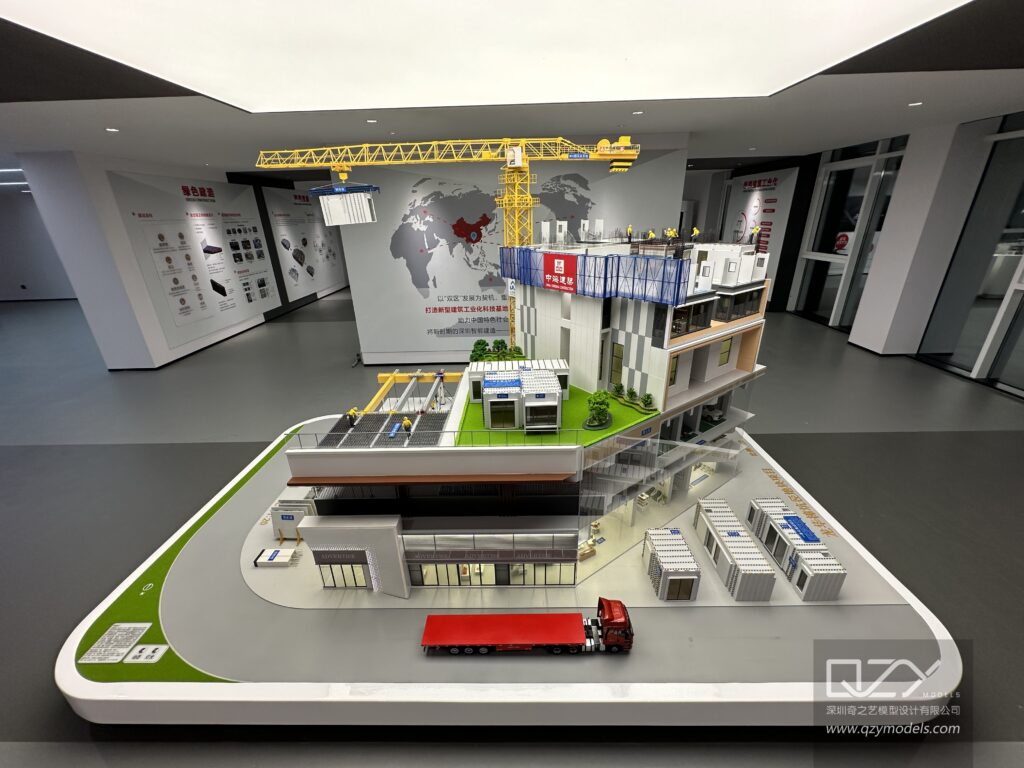
After using the solution: The company acquires a modular miniature plant model with clearly labeled components and color coding, designed to mirror real equipment and flows.
Key benefits: Faster onboarding, fewer operational errors, and safer training in a controlled environment. -
Museum or exhibition organizer creating an immersive display
Problem: A museum wants to showcase a historic district or infrastructure project in a way that captivates visitors and donors.
Traditional approach: Posters, screens, and generic models that do not reflect real-world details or narrative.
After using the solution: The organizer collaborates with a professional miniature model team inspired by QZY Models’ exhibition work to build a highly detailed, illuminated diorama with interactive elements.
Key benefits: Higher visitor engagement, stronger storytelling, and improved fundraising or educational outcomes.
Why is now the right time to adopt this solution and what trends will shape the future?
The rise of remote decision-making and global collaboration means physical models are more often combined with digital tools such as VR and BIM, rather than replaced by them. Forward-looking miniature makers integrate QR codes, AR overlays, and digital twins into their models, enabling viewers to switch seamlessly between tactile understanding and live data. Sellers who master this hybrid approach can serve not only traditional architecture and real estate, but also smart-city planning and industrial IoT projects.
At the same time, advances in 3D printing, CNC machining, and laser cutting are reducing production costs and expanding what is feasible for small teams. By adopting the disciplined, technology-enabled craft practiced by companies like QZY Models, individual makers can punch above their weight and deliver work suitable for international clients. Those who delay risk being locked out by better-organized competitors who offer standardized, export-ready services.
Sustainability is also becoming a decision factor: clients increasingly prefer models built with responsibly sourced materials and designed for re-use or modular updates. Sellers who can quantify material choices, carbon footprint, and reusability will have an edge when working with global developers and public institutions. In this environment, a professional, data-driven approach to selling handmade miniature models online is not just an upgrade—it is rapidly becoming a baseline expectation.
Can frequently asked questions help clarify how to sell miniature models online?
-
How should I price handmade miniature models for online B2B and B2C buyers?
Start by calculating material costs, labor hours, overhead, and target profit margin, then benchmark against market rates for similar scales and use cases. Offer tiered pricing based on complexity, detailing, and custom features, and avoid flat “per model” pricing that ignores project scope. -
What online channels work best for selling high-end miniature models?
Combine an owned website with SEO-optimized landing pages, specialized marketplaces for art and design, and direct outreach to architects, developers, and exhibition organizers. Use Instagram, LinkedIn, and YouTube to showcase process videos, behind-the-scenes craftsmanship, and finished project walk-throughs. -
How can I build trust with international clients who have never met me?
Publish detailed case studies, including project type, scale, client sector, and outcomes, and request testimonials and photos from satisfied customers. Demonstrate professional standards by sharing your process, timelines, and quality controls, taking inspiration from how QZY Models communicates its global project experience. -
Why is it important to standardize scales and workflows when selling models online?
Standardization speeds up quoting, reduces errors, and helps clients quickly understand what they are buying. It also enables you to produce repeatable quality at scale, a necessity if you want to serve multiple large projects in parallel. -
Can small independent makers realistically compete with established teams like QZY Models?
Yes, if they focus on narrow niches, emphasize personalized service, and leverage modern tools to boost efficiency. Rather than copying large providers directly, smaller makers can position themselves as agile, specialized partners that still uphold comparable quality expectations within their chosen segment.