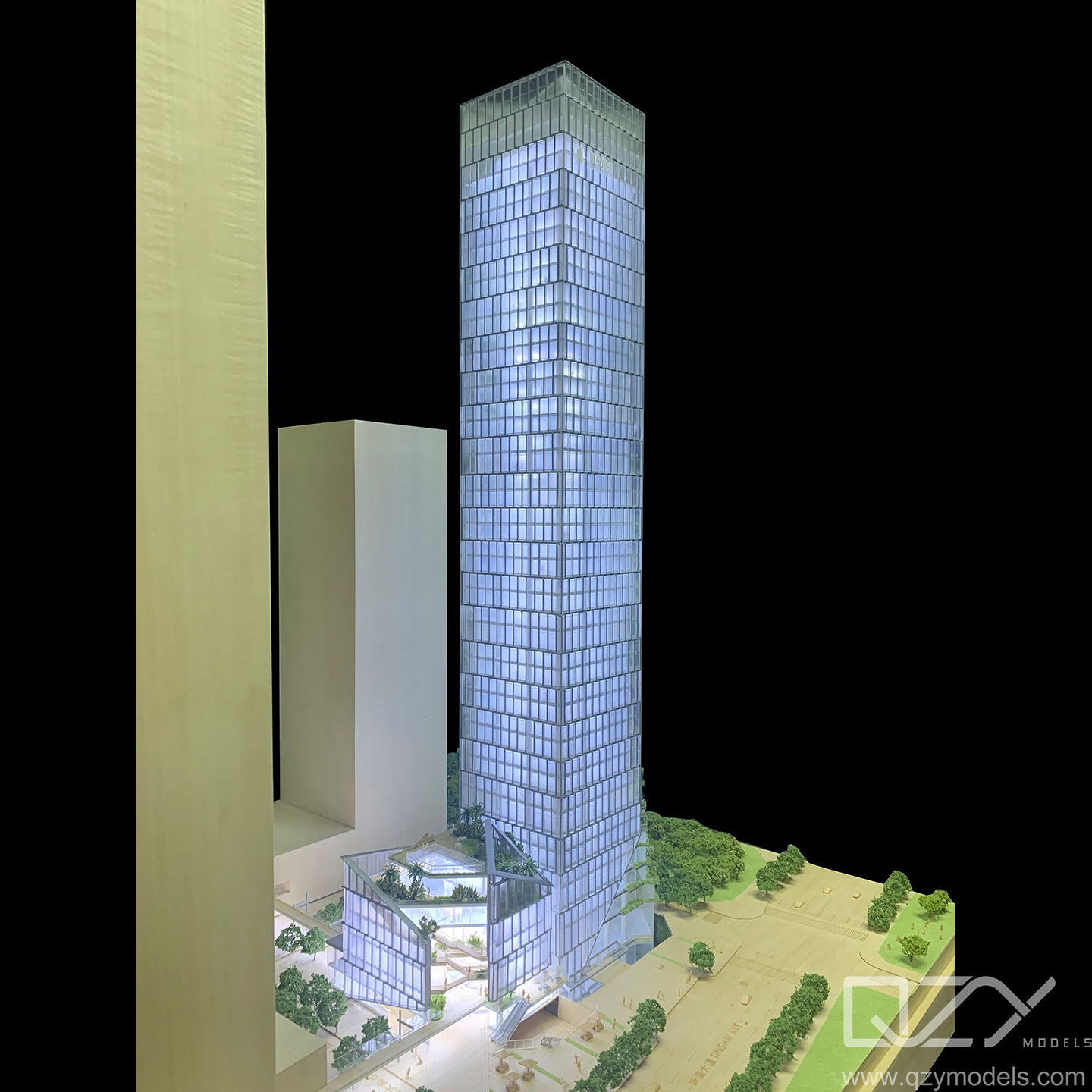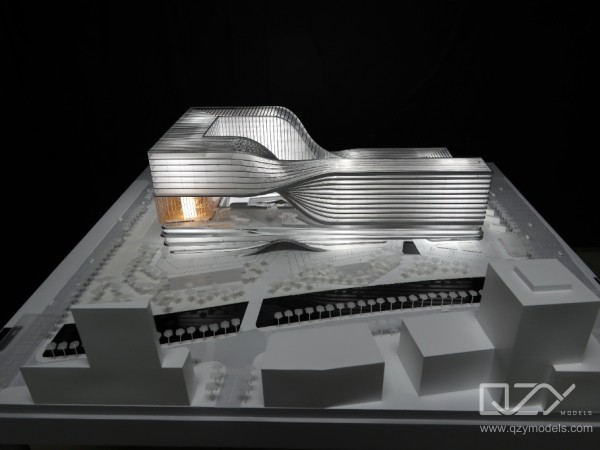
The Bigger the Project, the More Important the Small Model

Introduction: A Strange Paradox at the Heart of Development

There is a paradox that anyone who has spent time around major developments will recognise.

As a project grows, the tools used to design it become more advanced. Teams get larger. Software gets more powerful. Data gets richer. Budgets stretch into the billions, and the technology behind them keeps pace.

And yet, somewhere in the middle of all that sophistication, someone asks for a model. A physical one, made of card, acrylic, resin, and light, that fits on a table.

It seems like it should be the other way around. The larger and more complex the project, the less a small physical object should matter. In practice, the opposite is true. The bigger the project becomes, the more important the small model gets.

This article explains why, and what it means for developers, architects, and investors working at scale.
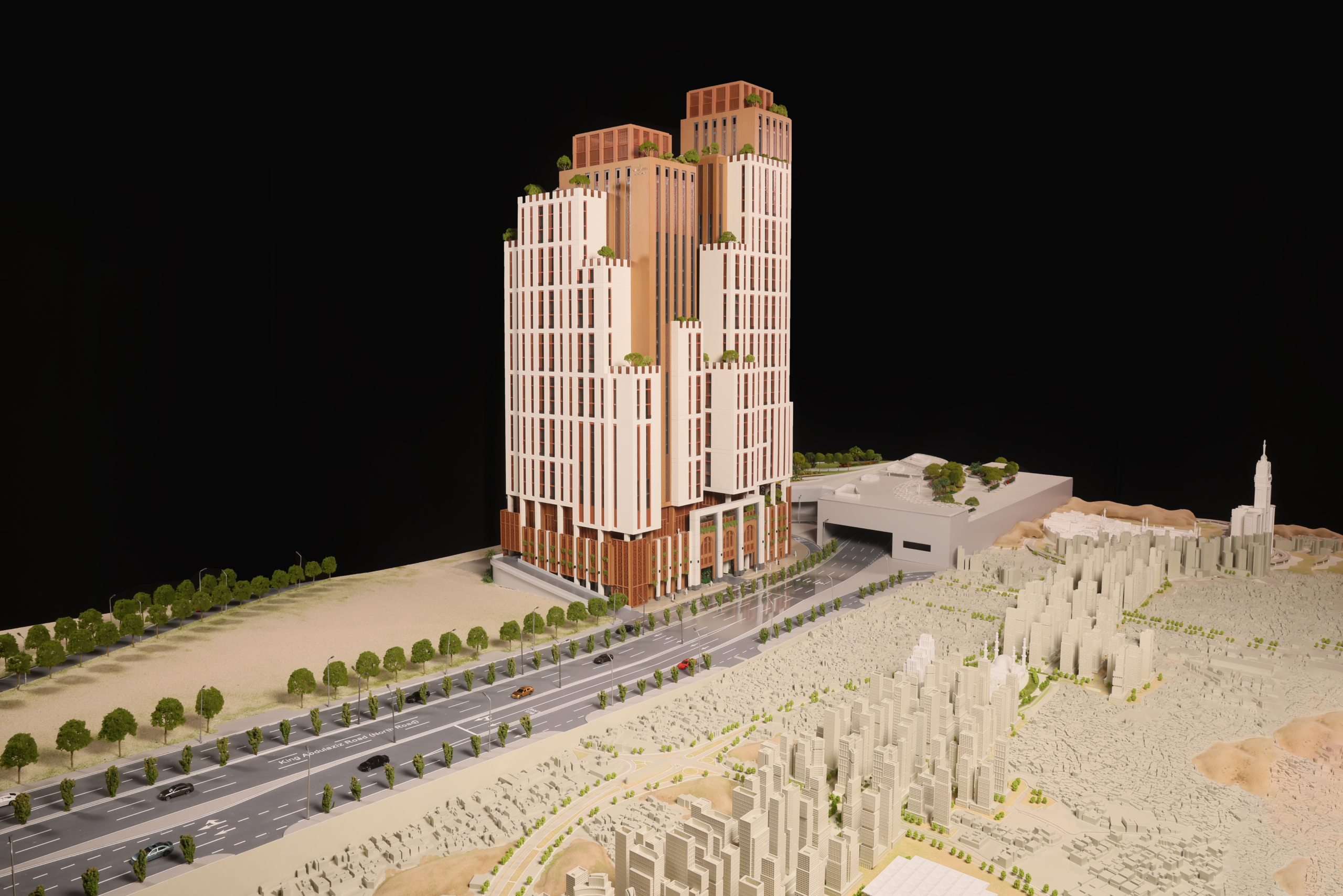
Large masterplan architectural scale model showing an entire urban district on one table
A large-format masterplan scale model on a single table, bringing an entire district into one room.


The Problem With Scale

Large projects share one characteristic that has nothing to do with money: nobody can see all of them at once.

A masterplan covering hundreds of hectares exists as hundreds of drawings. A new district is split across dozens of consultants, each responsible for a slice. A giga-project might be reviewed by one team looking at transport, another at landscape, another at buildings, another at phasing, and another at the finances. Every specialist understands their part. Very few people understand the whole.

This matters because the people who make the biggest decisions on a large project are rarely specialists in any single part. A minister approving a district, an investment committee backing a masterplan, a board signing off a multi-year programme: these decision-makers need to grasp how everything fits together, and they usually have limited time to do it.

Large projects create a communication problem that grows faster than the project itself. The bigger the scheme, the harder it becomes to hold it in your head, and the more valuable anything that lets you do so becomes.


What a Small Model Does That a Large Project Cannot

A scale model solves this problem in a way that no other medium quite manages. It compresses a project of enormous physical size into an object a person can take in at once.

It puts the whole project in one view. On a screen, scale is always hidden. You zoom in, you zoom out, you pan around, and at no point do you see everything at the same time. A physical masterplan model gives the whole scheme a single, fixed, shared view. Everyone in the room is looking at the same thing at the same size.

It shows relationships, not just elements. Large developments succeed or fail on how their parts relate: how the towers sit against the park, how the transport hub connects to the retail core, how the waterfront meets the residential blocks. These relationships are very hard to read from separate drawings. On a model, they are simply visible.

It exposes problems early. Placing a physical model of a large scheme in front of a team often reveals things nobody noticed in the drawings: a tower overshadowing a plaza, a road layout that cuts off a neighbourhood, a landmark that is lost in the skyline. Finding these issues at model stage costs a conversation. Finding them in construction costs millions.

It gives everyone the same understanding. This is probably its most valuable quality on a large project. When dozens of consultants, officials, and investors are looking at one object, they are no longer each carrying a different mental picture of the scheme. They share one.


Why It Matters Most in Giga-Projects and New Cities

Nowhere is this more visible than in the largest developments being planned today. Across the Gulf and beyond, new districts, waterfront cities, and entire urban regions are being designed on a scale with very few historical parallels.

These projects have three features that make a physical model especially valuable.

They depend on investor and government belief. Many of the largest schemes are, in their early years, a promise rather than a place. There is no skyline yet. There is a plan, a budget, and a vision. Getting stakeholders to commit to something that does not yet exist is one of the central challenges of the project, and a model makes the vision tangible in a way that figures and renderings struggle to match.

They involve very diverse audiences. A single masterplan may need to be presented to government leaders, international investors, local communities, future residents, partner developers, and the press. Few other tools work across all of these groups without translation. A model does.

They unfold over many years. Large developments are built in phases across a decade or more. A model can be updated, extended, and reused through the life of the project, giving it value long after a single presentation.

The scale of the project makes the model more important for a simple reason: the cost of misunderstanding grows with it. On a small scheme, a misread drawing is an inconvenience. On a large one, it is a risk to the entire programme.
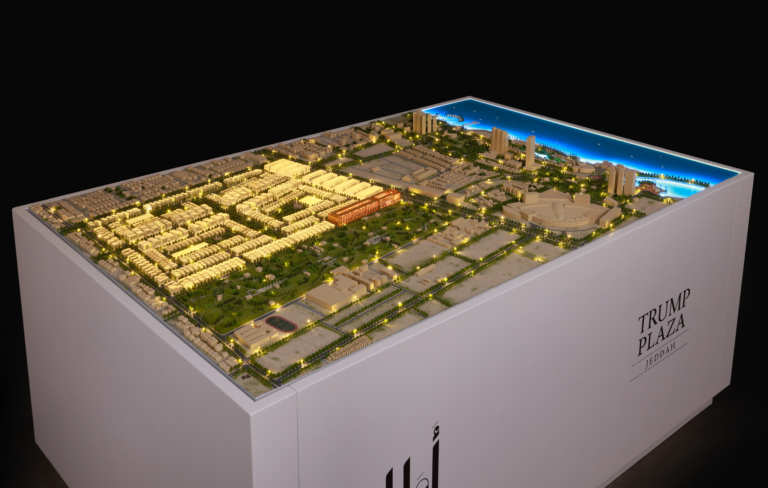
 

 A phased masterplan model showing completed and future phases in different finishes, a single object that tells the story of the whole programme.
Phased masterplan scale model showing completed and future development phases in different finishes


The Model as a Decision Tool, Not a Display Piece

It is tempting to think of a masterplan model as a showpiece: something impressive to put in a lobby or an exhibition hall. It can certainly be that. But on large projects, the most valuable models are often working tools.

In design development, a model helps teams test massing, skyline, and street relationships before they are fixed.

In approvals, it gives planners, regulators, and officials a clear reference for what is being proposed and how it sits in its context.

In fundraising and investor meetings, it anchors a conversation that might otherwise stay abstract, helping investors understand the project as a place rather than a spreadsheet.

In sales and marketing, it draws visitors in and helps buyers understand location, orientation, and neighbourhood.

In community engagement, it gives local people something they can approach, study, and respond to without technical training.

The same object, built once, serves every one of these moments. For a project of this size, that makes it one of the most efficient pieces of communication in the entire programme.


What Makes a Large-Scale Model Work

Not every masterplan model succeeds. The ones that do tend to share a few characteristics.

Clarity over complexity. At masterplan scale, the aim is not to show every window. It is to make the structure of the project legible: its roads, blocks, landmarks, open spaces, and hierarchy. The best models are edited carefully, and they emphasise what matters.

Accuracy that holds up. A large-scale model has to be trusted. Heights, footprints, and spacing need to be right, because decision-makers will rely on what they see. Precision here is a form of credibility.

Context included. A development is never an island. Showing the surrounding city, coastline, roads, and neighbouring buildings lets viewers judge how the project fits into the world around it.

Built to be used. Large models are moved, displayed, and handled over long periods. They need to be robust, easy to transport, and designed for the rooms and events in which they will appear.

Designed to evolve. On long programmes, the design changes. A model built with removable sections or interchangeable elements can be updated as the project develops, keeping it accurate and relevant for years.
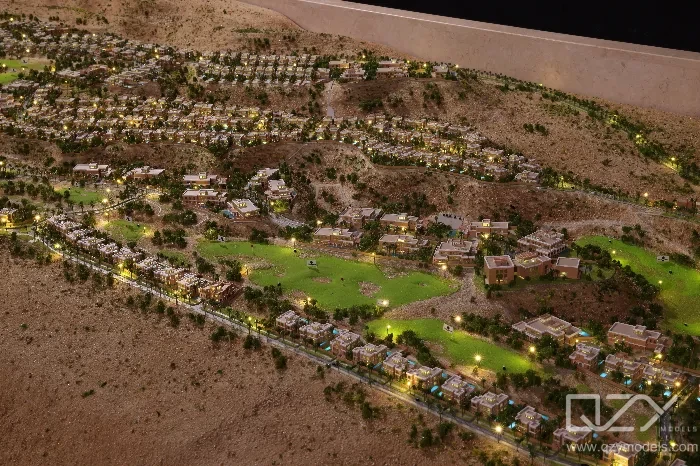
Close-up detail of masterplan scale model showing towers, streets, and landscaping at small scale
Close detail of a masterplan model, where accuracy at small scale builds confidence in the whole scheme.


The Quiet Advantage

There is something almost counterintuitive about all of this. In an era of immense computing power, the smallest version of a project turns out to be one of its most useful tools. But the reason is simple. Large projects fail less often from a shortage of information than from a shortage of shared understanding. A small physical model creates that understanding faster than almost anything else.

The bigger the project, the more people need to see it the same way. The bigger the investment, the more the people backing it need to believe in it. The bigger the ambition, the more it helps to hold the whole thing in your hands.

That is why, even on the largest developments in the world, the small model still has its place on the table.


Commission Your Masterplan Model

Our studio in Shenzhen produces precision masterplan and large-scale development models for developers, architects, and government teams across the GCC, Africa, and beyond. If you are working on a project where clarity at scale matters, we would be glad to hear about it.

Talk to our team about your masterplan model →
 

Share:

More Articles

Our Service

  • Make Architectural Models

    Our team of architectural model builders can assist you with dynamic displays that fit the scope of your project with solutions at large and small scales.

  • Make Urban Models

    Urban models are mathematical representations used to simulate and analyze urban development, transportation, and land use patterns for urban planning and policy decision-making.

  • Make Landscape Models

    Landscape models aid in regional, park, and urban landscape planning. We specialize in crafting professional landscape models tailored to your needs.

Send Us A Message

Add Your Heading Text Here

We pride ourselves on our Global Model Shipping and Installation Services, which ensure that your models are delivered safely to any city around the world. With over 20 years of experience in this field, we have honed our processes to provide a seamless and efficient service tailored to meet the specific needs of each project.

Comprehensive Shipping Solutions

Our extensive experience encompasses every aspect of the shipping process, including:

Expert Packaging: We utilize specialized packaging techniques to protect models during transit, ensuring they arrive in perfect condition. Our packaging is designed to meet the requirements of various transportation methods and the specific dimensions of each model.

Transportation Logistics: We carefully select transportation methods based on the nature of the model and its destination, considering factors such as budget, timing, and the most efficient route. We ensure that transportation aligns with the packaging size and requirements for safe handling.

Customs Compliance: Our team is well-versed in the import/export regulations of different countries. We handle all necessary documentation to facilitate smooth customs clearance and compliance with local laws, mitigating any potential delays or complications.

Climate Adaptability: We evaluate whether models are suitable for local climate conditions, ensuring that materials and finishes can withstand environmental factors in the destination city.

Professional Installation and Maintenance

In addition to shipping, we offer professional installation services that guarantee your models are set up correctly and functionally in their intended locations. We also provide ongoing support and maintenance, regardless of whether the models were produced by us or other manufacturers:

Thorough Inspection: We conduct comprehensive inspections of models upon arrival to ensure they meet quality standards and are free of any damage.

Maintenance and Repair: Our skilled technicians are equipped to perform routine maintenance, repairs, and refurbishments on models, acting as the “family doctor” for your models. No matter the issue, we are committed to restoring them to their best condition.

Adaptability to Local Practices: We take into account regional differences in model upkeep and care, providing tailored recommendations for maintenance based on local practices and environmental considerations.

Your Trusted Partner

At QZY Models, we understand that every detail matters in the shipping and installation process. Our commitment to quality service means we never shy away from challenges—no matter how complex the model or the issues at hand, we are here to ensure that your models look their best and perform optimally.

With QZY Models, you can rest assured that your models are in expert hands, backed by decades of experience and a dedication to excellence.

We offer comprehensive 3D printing services, including file design optimization, physical model printing, and post-processing services such as sanding and painting. Our 3D printing capabilities allow us to produce detailed and accurate models quickly and efficiently, with a wide variety of materials to meet the specific needs of your project.

Advantages of 3D Printing

Complex Shapes: One of the key benefits of 3D printing is its ability to create highly complex and intricate geometries that would be difficult or impossible to achieve with traditional manufacturing methods. This makes it ideal for producing intricate architectural models, sculptures, and industrial components.

Fast Turnaround: 3D printing can significantly reduce production time. Once the design is finalized, we can quickly move from concept to finished model, providing faster delivery compared to other techniques like CNC machining or handcrafting.

Cost-Effective: For small runs or prototypes, 3D printing is generally more cost-effective than other manufacturing methods, especially when dealing with complex designs that would require expensive molds or tooling in traditional fabrication.

Versatility of Materials: We offer a wide range of materials to suit different needs, including transparent, semi-transparent, and white resins, as well as ceramics, metals, red wax, and nylon. Each material has its unique properties, such as varying degrees of hardness, flexibility, and durability, providing greater flexibility in model creation.

Material Options: 3D printing supports a variety of materials, including:

Transparent and semi-transparent resins

Ceramics for more rigid and heat-resistant models

Metal for industrial-grade models

Nylon for durable and flexible prints

Red Wax for precision casting molds

Other Specialty Materials like white resin for detailed models

Disadvantages of 3D Printing

While 3D printing has many benefits, it does come with certain limitations:

Material Degradation: Some materials, especially those used for prototypes, can be prone to discoloration or deformation over time, especially when exposed to heat, light, or humidity.

Limited Surface Finishing: Certain materials used in 3D printing do not accept paint or other finishing treatments well, which can limit their use for final presentation models without additional post-processing.

Lower Precision: Although 3D printing is highly accurate for most applications, it has slightly lower precision compared to laser cutting or CNC machining, particularly in terms of fine details and surface smoothness.

Post-Processing Required: Most 3D-printed models require additional work after printing, such as sanding, polishing, or painting, to achieve the desired finish and smooth out imperfections.

Applications of 3D Printing

Our 3D printing services can be applied across various industries, including:

Architectural models

Industrial prototyping

Product design

Medical devices

Creative sculptures

Exhibition pieces

At QZY Models, we leverage the flexibility and efficiency of 3D printing to provide high-quality models tailored to your specific requirements. Our team can also assist in optimizing your 3D printing files for better results, ensuring the final product meets your design goals.

Our core expertise lies in crafting Custom High-end Architectural Models that transcend conventional techniques, materials, and forms. We specialize in delivering unique, tailored solutions that align with the creative visions of our clients. Our approach is driven by a deep understanding of the design intent, allowing us to create models that go beyond mere representation—they capture the essence and meaning of the architecture itself.

We believe that every design holds an underlying narrative, and our skilled team excels at interpreting and expressing this narrative through innovative modeling techniques. By closely collaborating with architects and designers, we ensure that the final model not only serves as a visualization tool but also acts as a source of inspiration, revealing new perspectives and highlighting the elegance and beauty that might otherwise remain unseen.

Our custom models are designed to amplify the architectural impact, bringing out the individuality, tension, and personality of each project. Whether you require a model for a cutting-edge skyscraper, a cultural landmark, or a visionary urban development, we are committed to delivering solutions that push creative boundaries. Our models are more than just physical representations—they are works of art that communicate the spirit of the design.

By utilizing advanced materials, state-of-the-art technology, and unconventional craftsmanship, we ensure that each model is meticulously crafted to meet the highest standards of quality and precision. Our innovative approach allows us to explore new methods and materials that best reflect the design’s unique character and purpose, providing clients with models that are both functional and aesthetically captivating.

Our expertise goes beyond architectural models. We offer comprehensive fabrication services for a wide range of physical models tailored to various industries and purposes. Our team specializes in creating precise, scaled-down models that bring concepts and designs to life, providing visual clarity and technical accuracy for diverse applications. These models are valuable tools for presentations, demonstrations, prototypes, and exhibitions. Our model categories include, but are not limited to:

Landscape Models: Capture outdoor environments with detailed representations of parks, green spaces, urban planning, and natural features.

Interior Design Models: Showcasing interior decoration designs, sectional structure designs, and spatial designs, providing detailed displays of interior environments.

Signage & Sculptures: Custom-made models for signage, artistic sculptures, and branding elements.

Industrial Models: Scaled-down versions of industrial equipment, machinery, and production lines for presentations, training, and technical demonstrations.

Mechanical & Engineering Models: Represent complex mechanical systems and construction processes in an easy-to-understand format.

Gift & Promotional Models: Unique and creative physical models for corporate gifts, promotional items, and special events.

Medical Device Models: Highly detailed replicas of medical equipment and devices used for demonstrations, training, and exhibitions.

Energy Equipment Models: Models of energy infrastructure, including renewable energy setups, power plants, and equipment, for industrial use.

Transportation Infrastructure Models: Scaled models of transport systems, including vehicles, stations, airports, and railway facilities.

Topographic & Terrain Models: Detailed geographic and topographic models for land development, environmental studies, and educational purposes.

Hydraulic & Water Facility Models: Representations of water management systems, including dams, water treatment plants, and irrigation systems.

Military Models: Models of military equipment, vehicles, aircraft, and naval vessels for research, education, and exhibitions.

Engineering Vehicles, Aircraft & Ships: Scaled replicas of construction vehicles, aircraft, and ships used in industrial and educational displays.

Figurine & Animal Sculptures: Realistic and stylized models of humans, animals, or other characters for museums, exhibitions, and creative displays.

Whether you need a detailed representation of industrial equipment, a landscape design, or a precise medical device model, we ensure each project is custom-tailored to match your exact specifications. Using advanced fabrication techniques, including 3D printing, CNC machining, and laser cutting, we deliver models that meet the highest standards of quality and accuracy.

Our models are designed to support a variety of industries, providing practical solutions for demonstration, training, project development, and marketing. We work closely with our clients to ensure every detail is captured, from material selection to scaling and finishing, creating physical models that are as functional as they are visually impressive. 

我们提供全面的设计解决方案,通过精湛的工艺和尖端技术将您的愿景变为现实。我们的团队擅长制作定制模型设计,以满足每个项目的独特需求,无论是建筑展示、城市规划、展览还是开发展示。

专业工艺:我们经验丰富的专业人员将您的想法转化为细致的模型,确保每个项目的精确度和质量。

材料灵活性:我们提供多种材料选择,包括木材、丙烯酸和 3D 打印组件,以适应各种建筑风格和设计偏好。

创新技术:利用先进的 3D 打印和激光切割技术,我们确保每个模型的细节复杂而精确,即使是最复杂的设计也能提供高质量的结果。

项目类型的多样性:无论是住宅建筑、商业综合体、城市开发还是展览模型,我们都会调整方法来满足每个项目的独特需求。

我们对创新和质量的承诺确保我们设计的每个模型都与您的愿景完美契合,使您的项目脱颖而出并留下持久的印象。