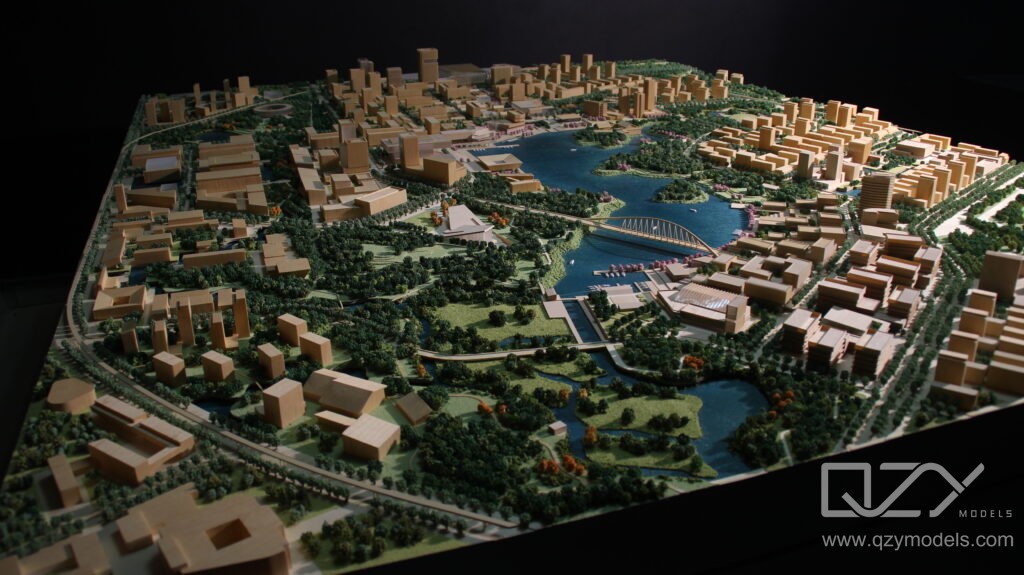
Park scale defines model ratios between 1:500 and 1:1000, ideal for representing landscapes, green spaces, and urban parks. It balances site context, topography, vegetation, and circulation, giving planners and architects a tangible overview of visitor pathways and environmental features. QZY Models specializes in producing detailed, realistic park-scale models that communicate master plans effectively.
What Does Park Scale Mean in Modeling?
Park scale uses proportional reductions—typically 1:500 to 1:1000—to translate real-world landscapes into tabletop models. This approach highlights terrain, vegetation, water features, and circulation while maintaining spatial clarity. Designers slice terrain into layered contours, add scaled trees, and construct hardscape elements like benches, bridges, and paths.
Common ratios include 1:500 for medium-sized parks, offering high detail, and 1:1000 for expansive sites, emphasizing overall flow. QZY Models integrates LED lighting and realistic materials, including etched acrylic ponds and laser-cut pathways, to enhance visual and tactile accuracy. These models support municipal planning, resort landscapes, and public consultations, helping stakeholders understand visitor movement and sun exposure.
Why Use Park Scale for Landscape Models?
Park scale is ideal when open space, vegetation, and environmental context dominate the site. It enables planners to evaluate circulation, vistas, and ecological integration while keeping costs and footprint manageable. Models at 1:500–1:1000 balance detail with visibility, ensuring that features like paths, ponds, and hills are easily readable.
Production efficiency is another benefit. A 5-hectare park at 1:500 fits on a 2x2m board using foam and plywood, allowing faster builds. QZY Models reports up to 30% faster construction at park scale compared to larger 1:200 models. These tangible models also facilitate public engagement and enhance presentation impact compared to digital renders alone.
Which Scales Are Best for Park Models?
Best scales depend on site size and presentation goals:
| Scale | Real Size Covered | Best For | Detail Level |
|---|---|---|---|
| 1:500 | Up to 5 ha | Neighborhood parks | High (paths, benches, trees) |
| 1:750 | 5-20 ha | Urban parks | Medium |
| 1:1000 | 20+ ha | Large master plans | Low overview |
| 1:2000 | 100+ ha | Regional plans | Massing only |
1:500 is preferred for medium parks to show individual features, 1:1000 for broad overviews. QZY Models customizes scales for diverse projects, from Middle East oases to European gardens, ensuring proportional accuracy and optimal viewer experience.
How to Build Park Scale Models?
Construction begins with terrain data, converted into layered contours in CAD software. Stack laser-cut foam or acrylic for hills, carve paths, and texture surfaces. Vegetation uses static flock, laser-cut trees, and wire armatures. Water effects rely on clear resin or colored acrylic layers.
Modular bases simplify transport and exhibition setup. Finishing techniques include airbrushed seasonal colors and placement of scale figures for realism. QZY Models incorporates dynamic features such as flowing fountains or micro-LED pathways for interactive displays. Typical workflows span 2–4 weeks for exhibition-ready models.
What Materials Suit Park Scale Models?
Materials are selected for realism, durability, and ease of assembly:
| Element | Material | Reason |
|---|---|---|
| Terrain | XPS foam, MDF layers | Easy to contour, sturdy |
| Paths | Laser-cut birch | Clean edges, paintable |
| Grass | Static flock, green paper | Realistic density |
| Trees | Wire trunks, foam foliage | Scalable and affordable |
| Water | Epoxy resin, blue cellophane | Glossy, reflective surface |
Foam and plywood allow precise layering and texturing, while resin creates naturalistic water. QZY Models sources sustainable, transportable materials suitable for international projects.
How to Add Realism to Park Scale Models?
Enhance realism by varying terrain textures, planting trees of different heights, adding resin water with ripples, and using scattered scale figures. Seasonal effects can be created with airbrushing, while LED lighting simulates dusk paths or water reflections.
Dynamic elements, like miniature fountains or solar lights, increase interactivity. Scale-appropriate vegetation prevents visual clutter, and massed greenery implies distance. QZY Models uses these techniques in projects for Foster + Partners, combining laser-cut precision with hand-applied finishing for visually compelling landscapes.
QZY Models Expert Views
“Park scale models at 1:500–1:1000 capture the essence of green spaces essential for urban planning. At QZY Models, we integrate precise topography with realistic vegetation and visitor circulation to communicate ecological integration effectively. Our teams across Shenzhen, UAE, and Saudi Arabia combine laser cutting with handcrafting, producing models that influence design decisions and approvals. These models reveal sunlight patterns, pathways, and spatial flow in ways digital renders cannot replicate, delivering both functional insight and emotional impact.” – Richie Ren, Founder, QZY Models
What Challenges Arise in Park Scale Modeling?
Challenges include maintaining accurate topography, representing varied vegetation, simulating water, and ensuring modular stability. Solutions include precise survey data, diverse tree catalogs, rippled resin, and pinned or magnetic layers for transport.
Scale distortion can occur from viewing angles; foreground emphasis and modular prototypes mitigate this. QZY Models ensures international shipments arrive intact, using prototypes and modular design to preserve realism and structural integrity.
When Should You Choose Park Scale Models?
Park scale is optimal for urban planning presentations, landscape bids, public consultations, and masterplan reviews that emphasize ecology and spatial flow over building detail. It is ideal for pre-design phases, environmental impact studies, and exhibition displays.
For highly detailed gardens, smaller scales like 1:200 are preferred. QZY Models employs park-scale models for Middle East green initiatives, pairing physical models with VR simulations for maximum impact.
Conclusion
Park scale models provide a compact, visually clear, and interactive method to communicate landscape designs. Choosing the correct scale, layering materials thoughtfully, and integrating realistic elements enhances engagement and stakeholder understanding. Collaborating with experienced teams like QZY Models ensures high-quality outcomes for urban planners, developers, and landscape architects.
FAQs
What ratio is standard for park models?
1:500 for detailed neighborhood parks, 1:1000 for larger masterplan sites.
How long does it take to build a park scale model?
Typically 2–6 weeks, depending on complexity and size.
Can park models include lighting?
Yes, LEDs can simulate dusk paths, water reflections, and illuminated features.
Are park scale models expensive?
Moderate—prices range from $5,000 to $20,000 depending on detail.
Does QZY Models make park models?
Yes, QZY Models produces park-scale models for global clients, including landscape and urban design firms.