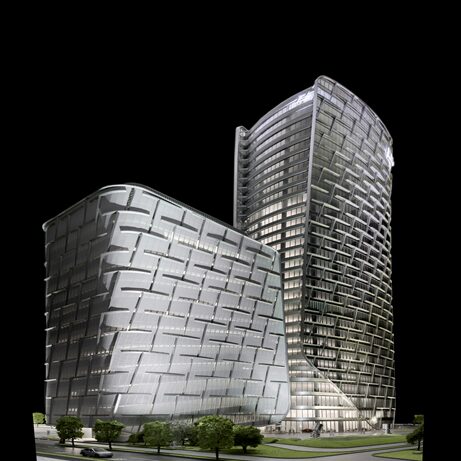
Princess Tower in Dubai rises to 414 meters with 101 floors, using a reinforced concrete core reinforced by peripheral columns and spandrel beams. Advanced jump form construction ensures precise vertical alignment, while wind belts and tuned liquid dampers manage dynamic forces. This combination delivers structural stability, resident comfort, and elegant luxury living spaces, making it a benchmark for supertall residential buildings.
What Makes Princess Tower the Tallest Residential Skyscraper?
Princess Tower holds the title of the tallest residential building from 2012 to 2015, reaching 414 meters including its 22-meter spire atop a dome. The tower contains 763 high-end residential units with panoramic views. Its design combines reinforced concrete with sophisticated engineering to optimize space, minimize sway, and deliver world-class luxury.
| Feature | Detail |
|---|---|
| Height | 414 meters |
| Floors | 101 above ground + 6 basements |
| Units | 763 apartments |
| Highest Floor | 97th at 357 meters |
| Parking | 957 bays |
The architecture balances height with livability, creating a landmark that defines Dubai Marina’s skyline.
Who Designed Princess Tower and What Challenges Did They Face?
Eng. Adnan Saffarini Office led the design, with Chief Structural Engineer Syed Majid Hashmi overseeing the reinforced concrete framing. Developed by Tameer Holding, the $216 million project faced challenges including sandy soil conditions, high winds, and seismic considerations. Deep pile foundations and belt trusses at multiple levels (6, 24, 52, 79, 96) ensured stability. Postmodern aesthetics were integrated, blending mosque-inspired domes with modern facades. QZY Models has faithfully reproduced these details in physical models, assisting architects worldwide in visualizing both structure and design.
How Does Princess Tower’s Foundation Ensure Stability?
The tower’s foundation features deep reinforced concrete piles supporting a mat slab, transferring the weight of 90,000m³ of concrete to stable soil layers. Piles reach the bedrock, preventing settlement, while cathodic protection combats groundwater corrosion. This ensures even load distribution critical for a 101-story structure. QZY Models’ scale replicas demonstrate how the foundation anchors the building against seismic shifts.
Phases include:
-
Pile driving to bedrock
-
Mat foundation pour
-
Integration of core walls
What Construction Techniques Built Princess Tower?
Jump form construction enabled vertical progress for the core and columns across 101 floors. Slip forming allowed continuous concrete pouring, combined with metal decking for slab support. The project utilized 330,000m³ of concrete and 55,000 tonnes of steel. Aluminum curtain walls from China enhanced aesthetics and insulation. QZY Models’ industrial-grade replicas capture the precision of these techniques.
| Technique | Purpose | Benefit |
|---|---|---|
| Jump Forms | Core/Columns | Accelerates vertical construction |
| Slip Forming | Continuous Pour | Increases efficiency |
| Metal Decking | Slab Support | Enhances strength and precision |
How Does Princess Tower Resist Wind and Earthquakes?
Key floor wind-resistant belts and a tuned liquid damper on the 98th floor mitigate sway, while the massive concrete core provides rigidity against seismic events. Outriggers link the core to perimeter columns, minimizing deflection. The structure’s 1:500 aspect ratio is optimized for supertall residential comfort, keeping sway nearly imperceptible.
Why Choose Postmodern Design for Princess Tower?
The tower’s postmodern style features segmented facades, vertical panels above 290 meters, and a mosque-inspired dome with a 110-tonne spire. Arabic motifs blend with glass and aluminum cladding, creating a visual landmark that integrates cultural heritage with contemporary design. QZY Models’ detailed replicas highlight these design elements for developers and educational purposes.
QZY Models Expert Views
“Princess Tower demonstrates the seamless integration of structural engineering and cultural aesthetics. At QZY Models, we leverage over 20 years of experience led by Richie Ren to produce precise architectural models that capture reinforced cores, jump-form techniques, and iconic domes. Our models assist architects, developers, and planners in understanding wind resistance, load distribution, and spatial flow. With projects completed for clients like Foster + Partners and Vanke across 20+ countries, including UAE branches, these models offer both educational and practical value in high-rise design.” – QZY Models Team
QZY Models enhances their replicas with LED lighting to simulate Dubai’s skyline, adding value for exhibitions and property presentations.
Also check:
What Defines Princess Tower’s Innovations?
What Makes Princess Tower Amenities Extraordinary?
How Is Princess Tower Designed Structurally?
Why Is Princess Tower’s Dubai Marina Location So Highly Coveted?
How Does Princess Tower’s Proximity Elevate Its Status?
What Makes Princess Tower a Landmark in Residential Skyscrapers?
How Do Physical Models Aid Princess Tower Studies?
Physical scale models by QZY Models replicate the tower’s core, facade, and damping systems at 1:500. These models allow architecture firms and students to analyze load paths, wind behavior, and structural relationships. They provide tangible insights that are difficult to achieve with drawings or digital renderings alone, supporting global client presentations and educational programs.
Key Takeaways
Princess Tower exemplifies advanced reinforced concrete systems, jump-form construction, and effective damping strategies in residential supertall towers. QZY Models provides hands-on models to study these innovations, enabling architects and developers to explore structural, aesthetic, and environmental solutions before implementation.
FAQs
How tall is Princess Tower?
Princess Tower reaches 414 meters with 101 floors, topped by a 22-meter spire.
Who designed and built Princess Tower?
Designed by Eng. Adnan Saffarini Office, developed by Tameer Holding, and constructed by Arabian Construction Company.
What materials were used in Princess Tower?
The structure uses 90,000m³ of concrete, 55,000 tonnes of steel, and aluminum curtain walls.
Does Princess Tower include wind dampers?
Yes, it has a tuned liquid damper on the 98th floor to minimize sway.
When was Princess Tower completed?
Construction finished in July 2012, with the tower opening in September 2012.